
Abstract
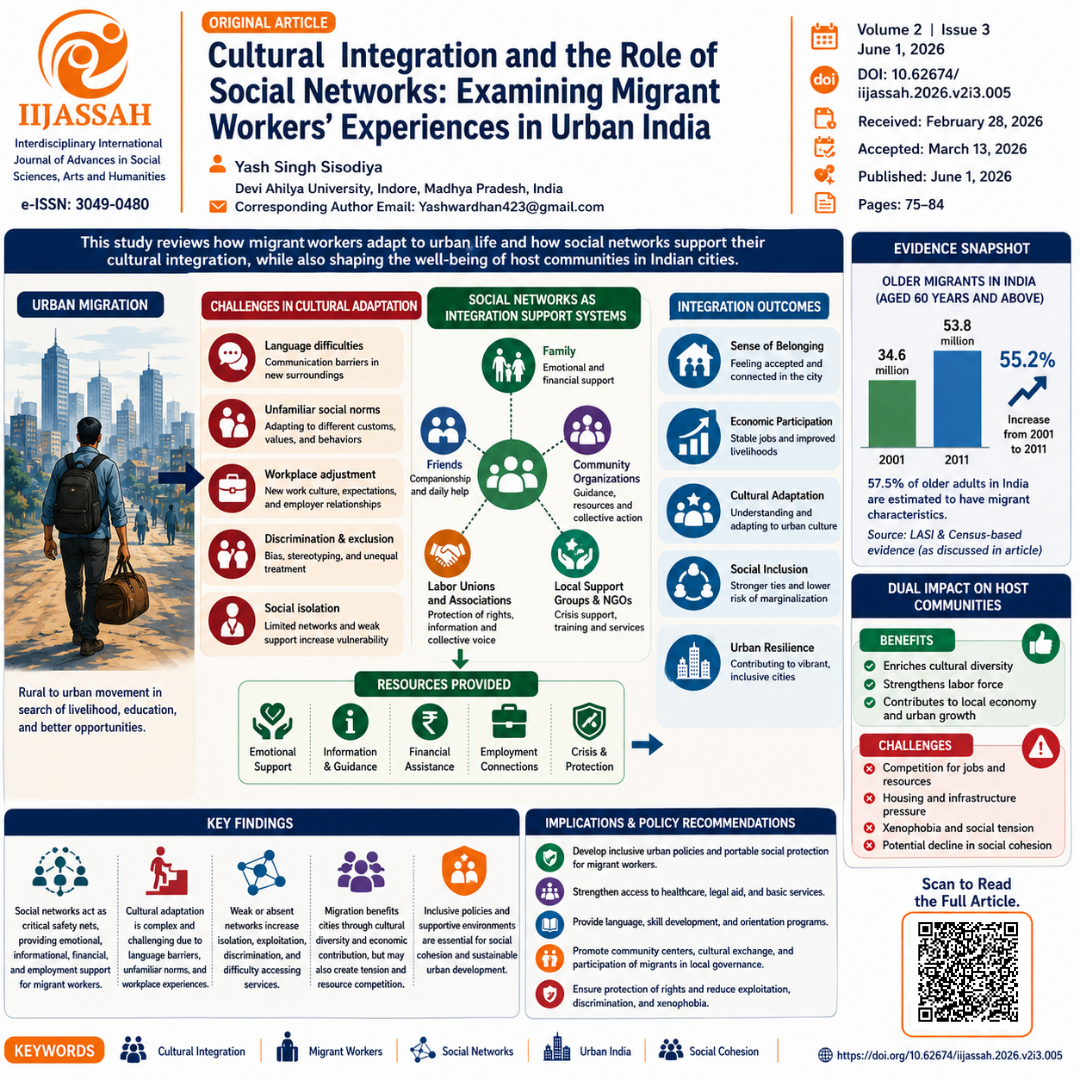
Introduction: This paper reviews literature on the cultural integration of migrant workers into urban India, giving particular emphasis to how they adapt to new surroundings and the roles social networks play in their adaptation. As processes of urbanization are happening at a rapid pace, with new growth paths of internal migration opening in many cities, experiences like this can become fairly important in furthering social cohesion and enhancing quality of life in the host city. Methodology: It is a mixed method design, in which qualitative interviews will be merged with quantitative surveys to tap the findings about diverse migrant populations in major urban centers. Indeed, results have shown that migrant workers go through painful cultural adaptation processes brought about by language difficulties, alien and strange social norms, and workplace interactions. Results: In fact, though, strong social networks-family, friends, and community organizations-are important bases for support that offer migrants emotional, informational, and financial resources to cushion the impact of the integration process. This is further buttressed by the fact that such migration indeed impacts the host local communities in a dual manner, on enriching cultural diversity and providing an added contribution to the local economy, but it also creates tension and challenges in social cohesion. Conclusion: The paper concludes in such findings and implications for policymakers with emphasis on inclusive policies that support migrant integration and contribute to harmonious coexistence. Therefore, this research contributes towards the general debate about migration and cultural integration in India by bringing to light information for scholars, practitioners, and policymakers who would want to ensure better experiences for migrant workers and, by extension, more robust urban communities. By realizing the role that social networks play and those things that impede migrants, cities can then become more resilient and inclusive to changed demographics.rs, and policymakers who would want to ensure better experiences for migrant workers and, by extension, more robust urban communities. By realizing the role that social networks play and those things that impede migrants, cities can then become more resilient and inclusive to changed demographics
Introduction
Indian migration has shown rapid growth, predominantly in urban areas, with shaped by factors such as economic opportunities, education, and socio-political reasons (Kundu, 2011); (Singh & Basu, 2020). It was due to this internal migration that the diverse migrant workers entered into cities, changing cultural landscapes and social relationships as a whole (Bhagat & Keshri, 2020). The paper aims to explore how exactly these migrant workers integrate into the urban(host) culture; more specifically, the adjustment to new environments, the social networks as agents of integration, and most importantly, how these migrant interactions impact local communities. Cultural integration is indeed significant for migrant workers, affecting their social identity and the chances of economic opportunities and overall welfare. The objectives of this research paper are:
- to observe whether the new cultural settings to which migrant workers are exposed have led them to adjust or adapt,
- the role of social networks in relieving integration challenges, and
- the estimation of the migrants' impacts on the host community's social cohesion levels.
Literature review
Literature on migrant workers in urban India has had considerable deliberations on the various trials and tribulations that migrants go through as they try to adapt to new cultural surroundings. One major wing of research literature had concentrated on cultural adaptation, social networks, and socio-economic effects of migration among the migrants and the host communities.
Cultural Adaptation
Cultural adaptation is necessary for migrant workers because they face all barriers in adjusting to the urban setting. Blynovaet al.(2020) Cultural adaptation becomes a very important process in the lives of migrant workers. Research shows, migrant workers undergo language barriers, unfamiliar cultural practices, and adjustment to new social norms (Kuzioret al.,2020; Balanteet al.,2021; Tharenou & Kulik, 2020). These scenarios result only in more alienation and isolation, especially for those with a weak support system in terms of social network. To cite this, Several reports reveals that most internal migrants hail from rural settings, wherein their social networks are established (Srivastava, 2020; Kauret al.,2023; Chowdhury & Upadhya, 2020). Being disconnected from such a social network while migrating to urban centers further makes them vulnerable to exploitation and discrimination. This research has pointed out that deficient social capital in urban areas can effectively play as a constraint to the adaptation process bringing about psychological stress and deterioration of mental health (Sarkaret al.,2021). Another relevant area concerning cultural adaptation is gender (Singh & Basu, 2020). It also throws light upon the hardships that female migrant workers face, an integral part of the labor force for industries such as construction and domestic work, related to discrimination and violence on grounds of gender (Jayaram & Varma, 2020). As per the results, such social exclusion and exploitation in the workplace may be a reason that barriers females face to settle culturally and socially (Deshingkar, 2021).
Role of Social Networks
Social networks have been a significant aspect that can assimilate migrant workers into the cultural life. These can be formal, or they are represented through the labor unions or organizations dealing with community service (Però, 2019). They can also be informal, such as members of the family and close friends (Baig & Chang, 2020). The research has shown that extensive social networks form an important resource base, more generally, and help migrants access resources, get employment, and orient themselves in the urban world (Pandeyet al.,2023). In the article by the Economic and Political Weekly, social networks become a critical network through which migrants get employment by referral mainly within the informal economy where most of the migrant workforce gets their employment (Marchang, 2024). Those social connections may also offer emotional support to help people manage the migratory and adaptation stresses (Domaet al.,2022). Further, from the Primary Research on migrant workers provided by Frontiers in Public Health Journal, the best role of networks has been proven as some sort of safety net providing support for such crises as health emergencies or loss of job (Yanget al.,2023). Such support could be invaluable in one's sense of belonging and community in the new surroundings, an important step towards effective cultural integration.
Socio-Economic Impacts of Migration on Host Communities
In this regard, the migrants not only adapt the host culture individually but also contribute by touching the communities that are already part of the present culture. It is in this sense that migrant workers increase the economic feasibility of cities since they fill in the labor gaps in construction, manufacturing, and services (Daset al., 2020). According to the data from the National Statistical Office, migrants form integral parts of the urban economies that migrate specifically for work, They tend to accept jobs that the natives would not touch, considering the low wages or the derogatory working conditions (NSO, 2022). This inflow, however, may also lead to tensions within the host community. These analyses portray the migrants as a potential danger to employment due to high competition for very limited jobs and resources amongst the host populations, hence giving cause to cases of xenophobia and social unrest (Ullahet al., 2020). For example, even the Indian Journal of Labour Economics reports cases that have characterized tensions between the locals and the migrant workers in places with higher levels of urbanization and economic changes (Srivastava, 2021). Additionally, causes like shortage of housing and insecurity of services would nullify the benefits that the socio-economic reaped from the migrants. This can result in several migrant workers turning up in slums or squalid areas, which are normally marked by a bad standard of living and therefore very little ease of access to other social facilities, such as health services or schools (Choudhury, 2023). Integration avoids the general development of this kind of urban region and might even worsen social inequality.
Theoretical Framework
This research will employ several theories related to migration and integration to provide a comprehensive understanding of the cultural integration process of migrant workers in urban India.
Key Concepts Cultural Integration: This process entails how immigrants assimilate the components of the host culture but retain their original culture with some cultural identity.
Social Networks: The web of relationships or connections that a migrant enters into with people who offer emotional, informational, and financial support in the act of integration.
Social Cohesion: This refers to the intensity of social bonding and collective feeling within a community. It could be influenced by migrant settlement.
Migration Theories
Acculturation Theory: Acculturation theory claims changes in culture could take place with cultural interaction between migrant workers and the host society. This theory thus feels that assimilation strategies are in dire need of all migrants moving to the host country. It also quotes four approaches of acculturation: assimilation, integration, separation, and marginalization. Knowledge of such approaches will help analyze how migrant workers interrelate with cultural identities in urban India.
Social Capital Theory: It is a framework that emphasizes the role played by social networks in providing resources and support to individuals. Social capital can be very strong in the case of migrant workers because it enables access to job opportunities, housing, and other social services in an easier way and allows assimilation. It is utilized to determine if social networks influence the cultural adaptation of migrants.
Transnationalism Theory: This theory highlights the bonds that the migrant continues to preserve with his or her countries of origin even while becoming settled in the host society. The theory highlights the dual identity of the migrant and the role that transnational networks create in the lives of migrants. It will be highly important in its contribution to understanding how the migrant labor harmonies cultural ties to communities at home with new identities in urban India.
Methodology
The research will collect and analyze existing secondary data related to the cultural integration of migrant workers in urban India. To this purpose, the present study will be a broad review of literature, reports, and statistics readily available from various academic journals, government publications, and non-governmental organizations.
Data Sources
Academic Journals: Peer-reviewed articles discussing cultural integration, social networks, and migration patterns in India.
Government Reports: Reports by the Ministry of Home Affairs and others that appear relevant with statistics detailing the trends and how policies could affect the lives of migrant workers.
NGO Publications: Reports from organizations working with the migrant population offering qualitative insights into the experiences of migrants, and the role of social networks in their integration.
Statistical Data: Statistics inferred from Census of India and other demographic surveys to give an idea, in quantitative terms, about the pattern of migration, socio-economic status, and demographic characteristics of the migrant workers.
The following data sources and platforms were selected to ensure transparency and diversity to enhance methodological rigor, defined inclusion criteria were utilized to select sources. Academic journal articles primarily identified through databases such as Google Scholar, Scopus, and JSTOR with the keywords such as “migrant workers in India,” “cultural integration,” “social networks,” and “urban migration.” peer-reviewed publications from the last 10–15 years were given priority to ensure contemporary relevance. On the parameters based on credibility, recency, and relevance to migration and urban policy the relevant Government reports were selected (e.g., Census of India, NSSO reports). For empirically grounded, field-based insights into migrant experiences, particularly in urban informal sectors the NGO publications were included. The exclusion of sources were done in case of lack of methodological clarity, empirical grounding, or direct relevance to the Indian urban context.
Discussion
The findings will be analyzed in relation to existing literature, emphasizing the interplay between cultural adaptation and social networks. The broader implications for understanding migration in urban India will be discussed, highlighting the importance of inclusive policies that recognize the contributions of migrant workers to society.
Migrant Workers Aged 60 and Above: Cultural Integration and Experiences in Urban India The Most less-explored area within the scope of Migration in India is elderly populations, especially those above 60 years. There is an increase in the number of the older workforce that was seen to urbanize-where they go in search of their family members or where they seek better living and health conditions. It focuses on the cultural integration experiences of older migrant workers in urban India, the specific challenges they face, and how they contribute to host communities.
Migration Trends Among Older Adults
For India, the LASI reports that more than half, or 57.5%, of the older people have the characteristics of migrants, and an important proportion migrates at or after achieving the age of 60, which is also supported by The census data that recorded the growth in the number of older migrants from 34.6 million in 2001 to 53.8 million in 2011, thereby a 55.2% growth (Ahamadet al., 2024). This demographic shift is important in providing reflection on a change of trends in migration within the country. Older migrants may stay, for example, because one can stay with family members, or to access better health facilities or flee from rural poverty and isolation. Motivations, however may vary to large extents by socio-economic status, the condition of health or even by family systems.
Cultural Integration Challenges
The culture adjustment issues of older migrants continue to pose much more difficult integration within the dominant culture than in any other place. Most of the old migrants find it hard to take off cultural adjustment disorders leading to estrangement and social isolation. Language could be another dimension in their integration because the elderly migrant group may not be as informed about the dominant languages used within the urban areas like Hindi or English. In an article published under BMC Public Health, it is indicated that older migrants are likely to report lower levels of social support than their non-migrant counterparts (Ahamed et al., 2024). Social support is prone to raising lonely feelings; simultaneously, it can prove to be a barrier for older migrants to become involved in the development of new social contacts and relationships within the urban environment. Older migrants are found with lesser probabilities of social engagement. This is highly essential to them and is important for their mental health and wellbeing. The migrants in this group have further prejudices regarding age, which influences their chances of working and access to social services. This in turn becomes a circle of exclusion where the older migrants cannot be fully involved in their new communities' economic and social life.
Contributions to Host Communities
Despite these adversities, the sociological perspective observes that older migrants can also be very beneficial to their host communities. Many older people possess important skills and expertise that they bring along, thus enhancing a given local economy. Old migrants, who may have previously worked in agriculture or the skilled trades, might be available for such informal sector activities as crafts or caregiving. However, elderly migrants are also an important component of family life, especially when there are many working family members for long hours in urban areas, to provide household chores and emotional well-being to their families as a system of childcare support to facilitate their own families and general well-being of their respective communities.
Policy Implications
Given the large scale of elderly migrants in urban India, the current situation dictates what are the imperative needs of the policymaker to be addressed in this regard. Rarely is it addressed that the current policies regarding the social milieu have actively left out the needs of older migrants. There is tremendous need to address focused interventions related to health-care access proper social support mechanisms and schemes of integration applied for older people. In this regard, to name a few, community centers may be constructed to provide social activities and support services geared toward the elderly. Communities can facilitate language classes, health screenings, and all other forms of social interaction that they would have had if they had not migrated, thus reinforcing bonds and improving the conditions of old migrants.
Impact of Migration on Local Communities
Social Cohesion
The impact to local communities is a two-way street that impacts social cohesion in either positive or negative ways. On the positive side, migrant workers would bring diversity to the cultures of a local community, encouraging different traditions, cuisines, and viewpoints in a community (Giglittoet al., 2021). Such cultural diversity might foster a good understanding and cooperate among different groups of peoples, hence enriching community life, but tension, confrontation, mostly when resources are scarce. The potential local populations view the migrants as threats in their struggle for available jobs and services. This can be given practical expression in the form of xenophobia and social unrest as a violation of social cohesion (Dempster & Hargrave, 2022). Accordingly, the Comparative Migration Studies opines that an economic recession or downturn often triggers such tensions in which migrants become easy scapegoats for the problems of society (Isaksen, 2019).
Policy Implications Socio-economic impact of the migration process and the call for reforms: This policy should be one that is more inclusive policy that serves both the interests of migrant workers and those of the local communities. The current policies are considered to be wanting on protection as well as support mechanisms towards their migrants, making them largely exposed to exploitation and further social exclusion (Barglowski & Bonfert, 2023). The National Human Rights Commission has also suggested reform in the areas such as access to social security, access to healthcare, and legal protection specifically targeted to the rural to urban migrant workers (NHRC, 2021).
It's also great to offer the possibility of change in systems such as language and skill training for the purpose of promoting participation in local community activities as well as forming labor unions to fight on behalf of the rights of migrants. An accommodative environment embracing the value added by migrant workers can reduce tensions and improve the social integration of the residents
There is an abundance of literature on the plights of migrant workers in urban India; however, most focuses on the orientation towards cultural integration and social networks that characterize them. Fully understanding those dynamics is absolutely critical for the development of effective policies for both migrant and host communities-critical for a better integrated and more inclusive society.
Conclusion
This research outlines the pertinent need for targeted interventions to overcome the multi-faceted challenges faced by aged workers in rural India. The analysis has shown that access to healthcare services is a direct consequence of geographical distances, financial constraints, and the unavailability of qualified personnel. For example, various elderly people travel more than 100 kilometers to seek basic health, consequently increasing out-of-pocket expense, further worsening their financial burden. This factor is compounded by the poor facilities available in the local centers of healthcare, which are usually insufficient to meet the special needs of geriatric patients.
Further, the social care given to the aging is of very low standard. With the erosion of the traditional family unit because of urban drift, many older people are left in a worse situation than their peers in extended family settings, owing to much more dependence on less formalized networks of support rather than providing them with any defined care. This inadequacy of strong social care sectors leads the aging workers to feelings of alienation and abandonment, affecting their psychological and mental health further. Interplay between health status and access to social care highly influences the labor participation of elderly individuals. Better access to social care facilitates remaining active in work activities whereas chronic health challenges lead them to withdraw from work, either by physical limitations or insufficient support. These withdrawals threaten not only economic stability but also their sense of purpose and social engagements. Socioeconomic factors are also considered to be an essential determinant of health outcomes among the aged. Poor socio-economic conditions existing in rural communities or rural settings increase vulnerability through lack of social support services and healthcare. Findings from the study reveal improvement in health outcomes of elderly workers can be thought of only after the eventual reduction of socioeconomic disparities.
The policy implications thus born from the study are both clear and unequivocal: there is a critical need to implement integrated strategies that should involve infrastructure development, provision of financial support mechanisms, training of the health personnel, and integration of health and social care services. Additionally, empowering the community through engagement and advocacy would lead toward more targeted interventions for the specific needs of older people. Lastly, it would be an understatement to appreciate the role of NGOs and community initiatives. They are fundamental to improving service delivery, articulation of rights of older persons, and building capacities at the grassroots levels. In their engagement, the gaps in service provision will be bridged, and resilience for the vulnerable will be strengthened. In a nutshell, this study postulates an urgency to coordinate an approach involving policymakers, community organizations, and local stakeholders to ensure older workers in rural India receive all support. By focusing on accessibility, better quality of services, and socioeconomic stability, we can improve the situation in this population group as a whole and encourage their active involvement in society.
Conflict of Interest
The authors declare that there is no conflict of interest regarding the publication of this paper. All research activities and findings have been conducted and presented with full objectivity and academic integrity.
Acknowledgement
The author would like to express their sincere gratitude to all those who contributed to the completion of this research. We are especially thankful to our mentors and colleagues for their valuable guidance, constructive feedback, and continuous encouragement throughout the study. We also extend our appreciation to the participants and institutions that provided support and necessary resources for this work. Finally, we acknowledge the unwavering support of our family and friends, whose understanding and motivation made this research possible.
References
- Ahamad, V., Bhagat, R. B., Manisha, & Pal, S. K. (2024). Social support and economic conditions among older migrants in India: do distance, duration, and streams of migration play a role in later life?. BMC Public Health, 24(1), 1843.https://doi.org/10.1186/s12889-024-19165-7
- Baig, R. B., & Chang, C. W. (2020). Formal and informal social support systems for migrant domestic workers. American Behavioral Scientist, 64(6), 784-801. https://doi.org/10.1177/0002764220910251
- Balante, J., Broek, D. V. D., & White, K. (2021). How does culture influence work experience in a foreign country? An umbrella review of the cultural challenges faced by internationally educated nurses. International journal of nursing studies, 118, 103930. https://doi.org/10.1016/j.ijnurstu.2021.103930
- Barglowski, K., & Bonfert, L. (2023). Migrant organisations, belonging and social protection. The role of migrant organisations in migrants' social risk‐averting strategies. International Migration, 61(4), 72-87. https://doi.org/10.1111/imig.13076
- Bhagat, R. B., & Keshri, K. (2020). Internal migration in India. In Internal migration in the countries of Asia: A cross-national comparison (pp. 207-228). Cham: Springer International Publishing. https://doi.org/10.1177/01171968261419873
- Blynova, O., Popovych, I., Semenova, N., Kashyrina, Y., Ursulenko, O., & Kononenko, O. (2020). Personality factors of choosing adaptation strategies in a different cultural environment by labor migrants from Ukraine. Amazonia Investiga, 9(32), 45-54. https://doi.org/10.34069/ai/2020.32.08.5
- Choudhury, D. (2023). Housing the seasonal migrants, a challenge for Urban Sustainability: The Case of India. Sustainability, Agri, Food and Environmental Research-DISCONTINUED, 11.https://doi.org/10.7770/safer.v11i1.2984
- Chowdhury, S. R., & Upadhya, C. (2020). India's changing cityscapes: work, migration and livelihoods. Institute for Social and Economic Change & National Institute of Advanced Studies. https://www.semanticscholar.org/paper/India%E2%80%99s-Changing-Cityscapes%3A-Work%2C-Migration-and-U-Roychowdhury-Upadhya/81e795c53e35c99221b6ebcb6783692899933bf9
- Das, P., Saha, J., & Chouhan, P. (2020). Effects of labor out-migration on socio-economic set-up at the place of origin: Evidence from rural India. Children and Youth Services Review, 119, 105512. https://doi.org/10.1016/j.childyouth.2020.105512
- Dempster, H., & Hargrave, K. (2017). Understanding public attitudes towards refugees and migrants. London: Overseas Development Institute & Chatham House, 3-18. https://odi.org/en/publications/understanding-public-attitudes-towards-refugees-and-migrants/
- Deshingkar, P. (2021). Why do migrants remain excluded in present-day India and what should we do about it?. In Migrants, mobility and citizenship in India (pp. 19-34). Routledge India. https://www.taylorfrancis.com/chapters/edit/10.4324/9780367765477-3/migrants-remain-excluded-present-day-india-priya-deshingkar
- Doma, H., Tran, T., Rioseco, P., & Fisher, J. (2022). Understanding the relationship between social support and mental health of humanitarian migrants resettled in Australia. BMC public health, 22(1), 1739.10.1186/s12889-022-14082-z
- Giglitto, D., Ciolfi, L., & Bosswick, W. (2022). Building a bridge: opportunities and challenges for intangible cultural heritage at the intersection of institutions, civic society, and migrant communities. International Journal of Heritage Studies, 28(1), 74-91. https://doi.org/10.1080/13527258.2021.1922934
- Jayaram, N., & Varma, D. (2020). Examining the “Labour” in Labour Migration: Migrant Workers’ Informal Work Arrangements and Access to Labour Rights in Urban Sectors. The Indian Journal of Labour Economics, 63. https://doi.org/10.1007/s41027-020-00288-5
- Kaur, S., Azad, S., & Gupta, A. (2024). Revealing hidden patterns in Indian migration using network analytics. International Journal of Information Technology, 16(4), 2455–2466. https://doi.org/10.1007/s41870-023-01703-y
- Kundu, A. (2011, September). Trends and processes of urbanisation in India. https://www.iied.org/10597iied?gad_source=1&gad_campaignid=218994421&gbraid=0AAAAADnD0aNP8FhxDemTEp3KEr-sdV_yM&gclid=Cj0KCQjw_vnQBhCxARIsADcZyxJIGCnzyi-tSht4r_nY5tm-XHXhKxGGDZk5YRFW31Q76iXCzpxCsRkaAmS5EALw_wcB
- Kuzior, A., Liakisheva, A., Denysiuk, I., Oliinyk, H., & Honchar, L. (2020). Social Risks of International Labour Migration in the Context of Global Challenges. Journal of Risk and Financial Management, 13(9), 197. https://doi.org/10.3390/jrfm13090197
- Marchang, R. (2022). Social networks, job search flexibility, employability, and mobility of migrant workers. Economic and Political Weekly, 57(30), 60-67. https://www.epw.in/journal/2022/30/special-articles/social-networks-job-search-flexibility.html
- NHRC. (2021). NHRC research study on Social Security and Health Rights of Migrant Workers in India gives several recommendations to the Centre and State Governments. The National Human Rights Commission. https://nhrc.nic.in/media/press-release/nhrc-research-study-on-social-security-health-rights-migrant-workers-in-india-gives-several-recommendations-to-the-centre-state-governments
- NSO. (2022). Migration in India 2020-2021 Periodic Labour Force Survey (PLFS) . New Delhi: Ministry of Statistics and Programme Implementation National Statistical Office. https://www.mospi.gov.in/sites/default/files/publication_reports/Migration%20in%20India%20RL16082023.pdf
- Pandey, A., Mishra, R., & Singh, R. (2022). Social networks as providers of social protection to urban migrants in Delhi. Asian and Pacific Migration Journal, 31(4), 426–453. https://doi.org/10.1177/01171968231154660
- Però, D. (2019). Indie Unions, Organizing and Labour Renewal: Learning from Precarious Migrant Workers. Work, Employment and Society, 34(5), 095001701988507. https://doi.org/10.1177/0950017019885075
- Sarkar, S. M., Dhar, B. K., Crowley, S. S., Ayittey, F. K., & Gazi, M. A. I. (2021). Psychological Adjustment and Guidance for Ageing Urban Women. Ageing International. https://doi.org/10.1007/s12126-021-09467-1
- Singh, C., & Basu, R. (2020). Moving in and out of vulnerability: Interrogating migration as an adaptation strategy along a rural–urban continuum in India. The Geographical Journal, 186(1), 87-102. https://doi.org/10.1111/geoj.12328
- Srivastava, R. (2020). Integrating migration and development policy in India: A case study of three Indian states. WP, 3, 10-18. https://knrajlibrary.wordpress.com/2020/08/24/integrating-migration-and-development-policy-in-india-a-case-study-of-three-indian-states1/
- Srivastava, R. (2021). Labour migration, vulnerability, and development policy: The pandemic as inflexion point?. The Indian Journal of Labour Economics, 63(4), 859-883. https://doi.org/10.1007/s41027-020-00301-x
- Tharenou, P., & Kulik, C. T. (2020). Skilled migrants employed in developed, mature economies: From newcomers to organizational insiders. Journal of Management, 46(6), 1156-1181. https://doi.org/10.1177/0149206320921229
- Ullah, A. A., Lee, S. C. W., Hassan, N. H., & Nawaz, F. (2020). Xenophobia in the GCC countries: migrants' desire and distress. Global Affairs, 6(2), 203-223. https://doi.org/10.1080/23340460.2020.1738951
- Yang, Y., Zhao, S., Lin, L., Qian, J., Zhang, H., & Cai, F. (2023). Social support and quality of life in migrant workers: Focusing on the mediating effect of healthy lifestyle. Frontiers in public health, 11,1061579. https://doi.org/10.3389/fpubh.2023.1061579