Abstract
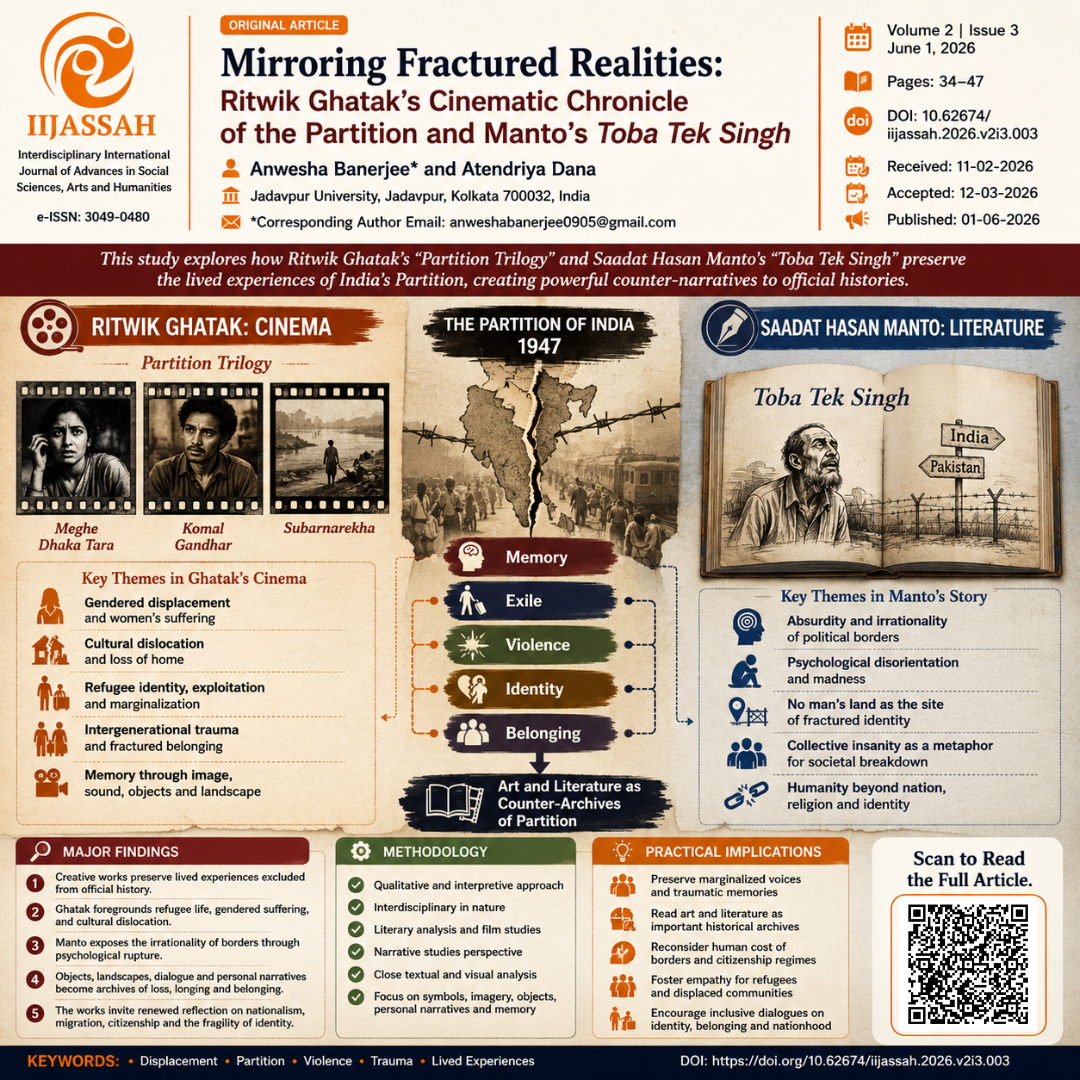
Introduction: This paper aims to study the interconnected legacies of Ritwik Ghatak’s cinema and Saadat Hasan Manto’s literature in the times of confusion in India when citizenship and belongingness are being questioned again, as reflective chronicles of India’s Partition, with a focus on Ghatak’s “Partition Trilogy” and Manto’s “Toba Tek Singh.” Through personal narratives and historical accounts, the paper builds on how everyday objects become archives of memory and yearning, surfacing the lived experiences that are often buried in sanctioned records of history. Against the backdrop of the Partition’s history of violence and continuing ordeal, the study situates Ghatak and Manto as artists whose work contests the society’s shared oblivion and honours exiled voices. Methodology: This article adopted a qualitative and interdisciplinary approach, combining literary analysis with film studies and narrative studies. Through close textual and visual analysis of the selected films and text, it examines how personal narratives, collective memory, symbols, imagery, and everyday objects function as sites of longing and reveals the lived experiences that are often obscured in sanctioned historiography. Results: The analysis sheds light on how both Ghatak and Manto reject aesthetic solace and confront the realities of violence, loss, and exile with unflinching nerve. Their works are read as subjective testaments, not merely as artistic expressions but as urgent meditations on the fragility of borders, memory, and identity in the face of historical upheaval. By fixating on the marginalised and silenced perspectives, they forge empathetic spaces for understanding the refugee experience. Conclusion: Ultimately, the paper contends that Ghatak’s films and Manto’s stories compel contemporary audiences to re-examine the ethical inferences of nationalism, migration, and historical memory, demanding a more inclusive reckoning with the enduring scars of displacement.
Introduction
India’s partition in 1947 remains one of the most traumatic disruptions in South Asian history, displacing millions and leaving back scars that continue to shape the cultural memory, identity and politics of the country till date. Abruptly, the population across the Indian subcontinent woke up to the realisation that belongingness was no longer a given. A hurriedly drawn line transformed neighbours into foreigners and homes into liabilities. People who had lived their entire lives in one place were suddenly bound to answer a question they had never been asked before: Where do you belong? Ghatak’s films depict the psychological weight of displacement, focusing especially on women’s experiences, the erosion of cultural identity, and intergenerational trauma. His cinematic frames critique sociopolitical structures, highlight the resilience and marginalization of refugees, and serve as counter-narratives to sanitized historical accounts. Manto’s seminal short story, Toba Tek Singh, stages the madness and irrationality of the Partition through the figure of Bishan Singh, a mental asylum inmate left stranded in no man’s land. Manto’s narrative employs collective insanity as a metaphor for the chaos and ruptured identities produced by Partition, exposing the deep psychological wounds inflicted on marginalized populations (Tiwari, 2013).
Literature review
Going far beyond its political ramifications, the partition was lived as a penetratingly personal tragedy that fragmented families, uprooted communities and created an enduring legacy of loss. It becomes imperative to listen to the stories of partition as told by the people who were there. Scholars such as Ayesha Jalal have argued that writers and film makers often convey this catastrophe with greater depth and reality than the formal process of historiography, as creative narratives preserve the intimate and emotional registers of memory that are often neglected by official records of history. Based on this argument, one needs to look at two critical cultural responses to the partition: Ritwik Ghatak’s Partition Trilogy, namely Megha Dhaka Tara, Komal Gandhar and Subarnarekha on one hand and Saadat Hasan Manto’s pivotal short story Toba Tek Singh on the other. It answers three interrelated questions: How do Ghatak’s films and Manto’s writings archive the lived experiences of displacement and violence, in what ways do their work act as counter narratives to the sanitised histories of partition, and how do they illuminate the psychological and intergenerational trauma, carried by marginalised voices, particularly refugees, and women. It is evident that both Ghatak and Manto confront partition, not as an abstract political event, but as an intimate experience of dispossession. While Ritwik Ghatak’s cinema registers the erosion of cultural identity and the gendered burden of displacement offering edges that expose the resilience and exploitation of refugee lives, Manto channelises the absurdity of borders through the figure of Toba Tek Singh, where insanity becomes a metaphor for fractured identities.
If one visits the partition museum in BR Ambedkar University, Delhi, there’s one particular section that holds everyday objects, not grand, not rare, just regular things. A chipped porcelain cup, a handkerchief with a name stitched on its edge, a book, a child’s toy. Things that seem trivial to the eye, but in that moment of forced departure and displacement, when people had no time to decide what to carry and what to abandon, these objects became repositories of love and belonging. It is impossible to not pause and think for a moment. How do you decide on what parts of your life to carry along when you are being exiled? How do you prioritise memories? The act of choosing in the middle of chaos is what makes these unassuming artefacts carry profound significance as they embodied the emotions of partition in ways that textbook history often overlook. However, as years passed, the horrors of the event have become more and more distant to the newer generations. The generations resounding the memories and receiving first-hand narrations has been continually substituted by new generations and a sense of collective amnesia where the partition has fallen many ranks lower, back into our reminiscences.
The essential argument that shall propel us forward is that memory of any incident doesn’t wear away with those who lived it but sustains itself through future manifestations like art and cinema (Hashmi, 2025) It is here that memoirs and other literary works become chief preservatory frames of those lived experiences. A body of literature and a handful of cinematic works were thus born, giving voice to the traumatic realities of partition. Today, it becomes imperative to study the literary works and the cinematic initiatives in order to understand not just an historical account of the partition, but the ‘lived experiences (Casey, 2023). Rather than just reading casual patterns of events, it becomes vital to lend an ear to the lost voices. It is very similar to how one talks about the Holocaust today. It is by building a close relationship between the memories and history of the Holocaust. Many scholars like Heidegger, Edmund Husserl, Henri Bergson have contributed to the understanding of lived experiences and how it shapes the understanding of the subjective nature of different phenomena. In philosophy, phenomenology and vitalist traditions have constantly stressed the importance of lived experiences in centrality to creating meaning and knowledge. Edmund Husserl argued that it is an imperative for philosophy to return to the ‘things themselves’ directing attention towards how phenomena appear in conscious experience rather than to abstract theoretical constructions. Building on this, Martin Heidegger shifted the focus towards existing structures of human life, terming humans as entities who’s understanding the world rise from being situated in it and their everyday involvement with it. The primacy of immediate ‘lived duration’ was stressed on by Henry Bergson who argued that the reality is seized more precisely through instinctive experiences other than purely analytical thoughts and ideas. Taken together these thinkers emphasize that lived experience is not merely subjective experience but are meaningful in shaping perceptions, understanding and creativity (Moran, 2000). The discussion begins with an emphasis on individual lived experiences directly connecting to subjective experience, which is an individual experience from a first-person perspective. Subjective experience constitutes psychological factors, such as emotions, perceptions, preferences, et cetera, and are very relevant to that person’s private world (Lilja and Josephsson, 2017). As Wilhelm Dilthey has rightly emphasised the importance of lived experiences lies in studying human sciences apart from natural sciences which rely on scientific observations, it is extremely important to understand human experiences which helps grasping the meaning of a particular context (Casey, 2023). Historians like Ritu Menon, Kamla Bhasin, Ranabir Samaddar have evolved this unique style of writing history based on the memories of partition that captures the traumatic experiences and visual representations of the massacre. It is this common thread of lived experiences that binds Ritwik Ghatak of partitioned East and Saadat Hasan Manto of the West (Yusin, 2009).
The fundamental question that needs to be addressed in lexical priority is that why is it becoming so important to talk about the partition all the more in the contemporary sociopolitical milieu of the country? Firstly, for Bengal and Punjab, the memory of the partition has never really died out and lingers as passed down family histories, across the lanes of refugee colonies and in the stories exchanged over evening tea about trains boarded in panic, lands left behind, documents held like lifelines and identities lost. Nearly eight decades later, a similar anxiety has resurfaced, not through barbed wire or scarred borders, but resulting from an administrative action that assigns the citizens to recurrently prove their right to exist politically. On the 4th of November 2025, the government began a colossal exercise of revising electoral rolls across 12 states known as the Special Intensive Revision. This ongoing revision of electoral rolls, particularly its questionable implementation across several states including West Bengal, has been officially framed as a routine updating mechanism. Its stated purpose is benign, that is to remove duplicate entries, correction of errors, and ensure unerring voter lists. Yet on the ground, the experience of SIR feels far from routine. For many, it has become a happenstance with anxiety, confusion, and a crawling sense of expurgation as numerous names have gone missing from voter lists (PTI, 2025).
Government officials arrive with forms demanding not just confirmation but reaffirmation with photographs, signatures, updated details, proof of residence. The list of 11 documents that the election commission has asked for in order to prove citizenship, are quite challenging. Seeking educational qualifications like 10th/12th marksheets, property documents do reflect the ways and means used by the colonisers as a way of providing citizenship to the educated and propertied select. This feat seemingly is recoiling a century of progress in advancing voting rights (Sagar, 2025). The responsibility of ensuring inclusion has quietly shifted from the state to the citizen. Voting, once a right, now feels like a conditional privilege, liable to one’s ability to navigate through complex paperwork, deadlines, and scrutiny. This isn’t a mere procedural shift; it runs deeper. It transmutes citizenship from a steady status into a provisional one. Those who have lived through the partition, or have inherited its memory, recognise this feeling instinctively. Today’s citizens facing the SIR are not being asked to cross borders, but are standing at an imperceptible brink - between inclusion and exclusion, recognition and suspicion. This has led to the creation of a bureaucratic no man’s land, where people exist physically but under a constant risk of being erased politically. When voters who have participated in elections for decades abruptly find their names missing, the message is not subtle: it reiterates that human existence is negotiable. The rightfulness is revocable.
This kind of unease is particularly acute in Bengal. The state’s history shaped by waves of displacement in 1947, 1971, and countless migrations in between makes refugeehood no anomaly; but structural. New neighbourhoods were built by those who arrived with little more than memory and courage. Documentation, wherever it existed at all, was often improvised, delayed, reconstructed (Kurosakiet.al.,2018). To subject such people to heightened scrutiny without robust safeguards is to reopen old wounds. The manner of implementation of the SIR, as it currently operates, does not merely correct errors; it produces suspicion. Citizens are subtly converted into subjects of verification. Possession of Aadhaar cards, ration cards, or even voter IDs does not necessarily safeguard individuals from further questioning. For linguistic, religious, or migrant communities, this scrutiny often intersects with political narratives about “illegal immigrants”, blurring the line between administrative review and ideological targeting (Sagar, 2025). The violence here is not loud and assertive. It is quiet, procedural, and therefore more difficult to contest. Bureaucratic violence does not show up with ammunition; it arrives with forms. It works by making people doubt themselves, their memory, their documents, their right to ask questions. For elderly voters, daily-wage workers, migrant labourers, and women dependent on male family members for paperwork, this process is more difficult. Missing a deadline, misunderstanding a form, or being absent during a verification visit carries disproportionate consequences. The threat is not always explicit, but it is deeply felt: What if my name disappears? This fear reshapes public behaviour. People begin to comply quietly rather than question openly. They internalise the idea that citizenship must be earned repeatedly. To be included is to be recognised; to be excluded is to be expunged. When such revisions are conducted without transparency, sensitivity, or accountability, they risk undermining the very legality they claim to protect. The lesson we derive of history is explicit. When citizens begin to fear the state’s definition of who they are, democracy hollows out from within. This is not an argument against updating voter rolls. Recognising administrative processes as lived experiences, not abstract systems is the key. A democracy must be on the side of inclusion, especially in a society marked by historical displacement. Bengal knows what it means to live the afterlife of borders. It knows the cost of turning human lives into clerical categories. To repeat that mistake, even in bureaucratic form is to ignore the warnings left behind by history.
Methodology
The central problem that this paper seeks to address is how did Ritwik Ghatak ‘s Partition Trilogy and Saadat Hasan Manto’s Toba Tek Singh represent and record the lived experiences of displacement, trauma, and identity crisis resulting from the partition of India, which often got neglected in the sanitised and accepted versions of history. The aim is to understand how these pieces of work function as counter-narratives, particularly in the context of contemporary anxieties around citizenship and belonging, how are these two artists, illuminating, psychological and intergenerational trauma amongst marginalised groups such as refugees and women and the importance of revisiting partition through these artistic works and how it is urgent in today’s social political climate. The aim is to pit lived experience against official historiography, counter narratives against state sponsored narratives and the cost of fragile human identity against the sanctity of political borders. The methods used to approach this objective is qualitative, interpretative and interdisciplinary, which includes closed, textual, and cinematic analysis of the primary texts- Toba Tek Singh and the Partition Trilogy. Characters, dialogues, symbolism, visual composition, cinematic framing, metaphors, gender representation, and active structures have been studied in a hermeneutic and interpretative way. Based on the theoretical framework of lived experiences and phenomenology, the article also builds on trauma studies, media studies, cultural theory, and partition historiography. This study, situates the films and the short story within a humanistic approach with first hand experiences embodied within.
Looking back: How did art respond then? - Textual and Narrative analysis
With a firsthand experience of partition related violence and trauma, Ritwik Ghatak a refugee from Bangladesh (Then East Bengal) used cinema as a medium to explore the devastating impact of displacement. His three most significant films, which are commonly referred to as the Partition Trilogy comprising Meghe Dhaka Tara (The Cloud-Capped Star), Komal Gandhar (E-flat), and Subarnarekha (The Golden Line) serves not just a medium of artistic expression but an emotional chronicle of the struggle to rebuild shattered lives in the wake of political violence (Regina, 2008). Through his films, Ghatak offers a critique of the nationalistic and political forces that contributed to partition’s aftermath, interweaving together themes of loss of identity, resilience, and the emotional toll of forced migration. Ghatak’s ability to capture the psychological weight of partition within cinematic frames ensures that his work stands as both a profound artistic achievement and a poignant historical document. His films invite the viewer to reflect on the personal and shared traumas of dislocation and to reconsider the impact of political decisions on the lives of ordinary people. By giving voice to the marginalized, particularly women, Ghatak contests dominant historical narratives by providing a space for the silenced experiences of refugees to be heard. While early Indian cinema was busy putting forward the accounts of the mushy and optimistic idea of Nehruvian consensus, Ghatak chose a different path (Kothari, 1969).
On the other hand, Saadat Hasan Manto remains one of the most important and politically significant writers of partition. Prolific yet controversial, Manto is known for short stories, exploring the grim realities of human nature and society. The post partition intolerance that overwhelmed the city of Mumbai seemed to be troubling this man who was not being able to come to terms with the fact that suddenly he was not Saadat Hasan, but just a Muslim refugee. Manto’s migration to Lahore was not voluntary and carried the baggage of dual belonging with him. In 1953, he got admitted to an asylum due to constant hallucinations about his life in Bombay. Till his death, the seven years that Manto survived in Lahore was full of suffering and poverty. He wrote profusely during this time. During these years, he wrote as many as 127 stories, coupled with numerous court cases winning almost all and continuing to write with the same boldness. Meanwhile, he engulfed himself to excessive drinking to be ultimately diagnosed with cirrhosis of liver, which contributed to the hallucinations. In many of his writing’s readers come across a confusion, inherent to the post partition society about where lies India and where lies Pakistan? Who was a Pakistani who was a Hindustani? Manto has written generously on partition starting with Siyah Hashiye- a collection of anecdotes of partition stories. He continued to make sketches and wrote numerous short stories like Haiwaniyat, Khaad, Qismat and many more depicting how religious symbols were used during sociopolitical upheavals. Talking of Khuda ki Kasam, which gives us insights into the abduction of ordinary people, which has been ignored by many historical accounts. However, the most vivid account based on his lived experience has been Toba Tek Singh (Sarkar, 2009).
Similar to Ritwik Ghatak’s expressions, the ones used by Manto, were explicit and bold, and both were in no disposition to provide aesthetics and feel-good factors to their audiences and readers. While Ritwik Ghatak’s approach to film making was rather blunt, direct and filtered of implicit ideas, Manto attracted considerable criticism by provoking the conservatives by depicting rudeness, sexuality, violence, and other unsettling aspects of human nature.
Partition as a Moment of Cultural Rupture
Tearing apart cultural, social and familial structures which had existed for centuries, the partition of India did more than just dividing a nation. The following massacre was especially intense and more lived in the regions of Punjab and Bengal provinces adjoining India’s borders with West and East Pakistan. Punjab and Bengal were witness to annihilations, forced conversions, mass abductions and unrestrained sexual violence with women being raped and left disfigured or dismembered (Dalrymple, 2022).
Partition fashioned a new category of people: Refugees. While refugees are often considered temporary migrants, in the case of partition, they became permanent beings, perpetually displaced and consigned to the margins of society (UN, 2024). For Ghatak, whose own family was displaced from East Bengal, the lived experience of displacement became the central theme of his work. In his films, a sense of cultural loss has been the central motif, as characters are leaving behind nationhood to navigate new identities in the face of erasure and violence. Ghatak’s cinema, therefore, becomes an act of reclaiming lost histories, offering a counter-narrative to the sanitized versions of history that often ignore the complexities of displacement (Butalia, 2017). Saadat Hassan Manto as well was a victim of partition, born in 1912 in India but migrated to Pakistan when the communal riots broke out. Dejected by the act of partition, he skilfully portrayed his feelings through his writings.
Results
The first instalment of Ghatak’s ‘Partition Trilogy’, ‘Meghe Dhaka Tara’ (‘The Cloud-Capped Star’, 1960), revolves around Nita, a young refugee woman from East Bengal, who sacrificed her personal dreams and health to support an impoverished family. Ghatak uses Nita’s story to build on themes of individual resilience, exploitation, and the gendered impact of partition.
In the film’s most iconic scene, Nita, on her deathbed, isolated in a sanatorium in Shillong, cries out: ‘‘Dada ami banchte chai” translated as Brother I wish to live! The declaration is not just a personal dirge but a universal expression of longing for life, dignity, and gratitude amidst despair. Her cry echoed in the hills, screaming the silent struggles of countless refugee women forced to shoulder responsibilities while being denied agency and acknowledgment. Nita becomes a symbol of emotional anguish, positioned as both a personal and collective representation of partition’s toll on the female psyche. The family dynamics in Meghe Dhaka Tara reflect on the broader crisis of displacement. Nita's losses are figurative of the refugee woman’s role as a caregiver, often at the cost of her own comfort are largely ignored by her brother, who is too absorbed into his own endurance. This disregard mirrors the apathy of the nation towards the refugee problem, where individual suffering was often overlooked. The film critiques the socio-political structures that perpetuate such marginalization and highlights the theme of forgotten histories, particularly of women in displaced communities (Chatterjee, 2023). The landscape of Shillong acts as a metaphor for Nita’s emotional state where the calmness of the hills contrasts sharply with her inner turmoil, amplifying her sense of alienation. This juxtaposition catalyses the viewer's understanding of the duality of existence that refugees often face being externally displaced while internally struggling to retain their identity and dignity. Nita’s sacrifices are reflective of a patriarchal society that exploits women’s labour while denying them autonomy. Ghatak critiques this inhumanity, presenting Nita not only as a victim of national catastrophe but also as a casualty of gendered societal expectations (Sarkar, 2009).
Komal Gandhar (E-Flat, 1961) is a reflection on cultural loss and the longing for unity. The film begins with a question: ‘Why must I leave? Can anyone make me understand? Leaving behind such an adorable country, parting with my river Padma, why must I take off?” is a cry full of despair of refugees grappling with their severed ties to homeland and identity. The narrative follows a theatre group and uses music and performance as metaphors for unity and resistance. The dialogue between an old actor and his co-actor underscores the cultural shock of dislocation. When the latter warns, ‘“This is the last chance to become refugees,” the old man answers in disbelief, “Refugee? a single word that encapsulates the bewilderment and mortification of those uprooted by partition. The characters’ struggles reflect the fragmented identities of refugees, torn between their past and present, their search for a new identity amidst the ruins of their lost homeland is central to ‘Komal Gandhar’. The film also problematises the idea of "home", that transcends geography to become a psychological and emotional space. The metaphor of the river Padma plays a key role in articulating this idea of a lost but still existing home (Butalia, 2017). Through music and interpersonal relationships, Ghatak portrays the yearning for a lost homeland and shared cultural heritage. Music, in Ghatak's cinema, is not merely an artistic expression but an act of resistance against the erasure of one’s cultural roots (Sarkar, 2009).
The final part of the trilogy, Subarnarekha (‘The Golden Line’, 1965), examines the intergenerational aspect of trauma. The film follows Ishwar and his sister Sita, who, after being displaced by partition, attempt to rebuild their lives. Their efforts, however, are marked by moral compromises, highlighting the recurring nature of displacement. Sita’s narrative arc reflects the compounded vulnerabilities faced by women, especially those from marginalized socio-economic backgrounds. Her descent into mental distress, culminating in her tragic death, exposes the intersectional oppression of caste, class, and gender that often goes unnoticed in the historical narratives of partition. The characters' inability to escape their past, despite their attempts to rebuild, reflects the profound psychological scars left by partition. The film exposes the contradictions of nation-building, where the promise of independence is overshadowed by the exclusion and marginalization of refugees. In ‘Subarnarekha’, Ghatak critiques the myth of post-independence unity, revealing how the creation of a nation often erases the humanity of its displaced citizens (Sarkar, 2009).
Partition’s impact on women has been particularly devastating. Over 75,000 women were abducted, raped, or mutilated, their bodies treated as sites of patriarchal and communal contestation (Mathur, 2017). Ghatak’s films challenge this reductionist portrayal, presenting women as active agents navigating complex realities. In Meghe Dhaka Tara, Nita’s journey from the domestic sphere to the public domain mirrors the broader redefinition of gender roles during partition. The refugee woman, for Ghatak, is a potent symbol of resilience, forced to endure not just the trauma of displacement but also the crushing weight of gendered expectations. The partition disrupted traditional gendered spaces, forcing women to step into public roles as breadwinners and decision-makers. Ghatak’s portrayal of this shift is nuanced, highlighting both the opportunities and the challenges the situation presented. Characters like Nita and Sita symbolize such challenges of refugee women who navigate patriarchal systems while carving out spaces for themselves in a changing socio-political landscape. Their journey underscores the importance of recognizing the gendered dimensions of displacement in both historical and contemporary contexts (Natarajan, 2018). Ghatak’s craftsmanship in arranging characters and objects in a frame reinforces the emotional and psychological undercurrents of his narratives. In ‘Meghe Dhaka Tara’, for instance, the cramped, muddled settings of Nita’s home visually represent the economic constraints she faces. One can also find the use of light and shadows symbolizing the emotions, the tension between memory and the present. The oppressive atmosphere in many of his films, from the claustrophobic interiors of refugee homes to the barren landscapes of resettlement areas, deepens the emotional gravity of the story. Ghatak’s films are crucial texts for understanding the cultural and emotional dimensions of partition as they complement historical accounts by putting marginalized voices at the centre and highlighting the complex human experiences of loss, grief, and survival. His works invite us to reflect on how we address the needs of displaced people in contemporary societies, urging empathy and solidarity. Ghatak’s cinema calls for a rethinking of national borders and identities, challenging the notion of a fixed, homogeneous nation-state in favour of a more inclusive and compassionate approach to global displacement (Mathur, 2017).
Ghatak creates a complex, multifaceted narrative that offers critical insight into the emotional and psychological toll of this national trauma. Ghatak’s ability to intertwine personal grief with the collective suffering of displaced people elevates his work beyond a mere reflection on historical events to a meditation on the universal experience of uprootedness. His films become a space for reflecting on the fragmentation of identity, the erosion of cultural memory, and the toll that such dislocation takes on individuals and communities. At the same time, Ghatak challenges viewers to rethink the notion of the nation-state, urging them to consider the moral and ethical implications of borders and the political structures that create and perpetuate displacement. His cinematic lens has been critiqued to be tainted by an indefensible empathy for marginalized voices, presents a rogue critique of societal and familial neglect, especially as it pertains to women and refugees. In ‘Meghe Dhaka Tara’, Nita’s painful sacrifices resonate as a metaphor for the exploitation and invisibility of refugee women. In ‘Komal Gandhar’, the longing for a lost homeland and the search for cultural continuity are embodied in the theatre group’s attempts to rebuild through art. In ‘Subarnarekha’, Ghatak brings forth the intergenerational impact of partition, where trauma is passed down through the years, reminding us of the long-lasting effects of forced migration (Mathur, 2017).
Toba Tek Singh: A rational irrationality
Manto in most of his works, like in Toba Tek Singh (1955), used a form of collective insanity that spread across the subcontinent to depict the effects of partition. It reminds us about the consequences of Sir Radcliffe scribbling on our land without even visiting it. The story revolves around a mental asylum and the life of the inmates during the partition period and begins by depicting the state and activities of various inmates, gradually fixating on Bishan Singh belonging to a village called Toba Tek Singh that lies somewhere near the newly drawn border of India and Pakistan. The government announced the exchange of inmates between the two newly formed countries based on religion and chaos. Singh is confused about the status of his own village and where it lies now. He is shown to become increasingly disturbed and keeps on asking about its location. At the end, when the authorities are attempting to relocate him, he lies down on a strip of no man’s land declaring that he belongs to neither India nor Pakistan. The story finishes, tragically, symbolising the profound loss and dislocation of many like Bishan (Chatterjee, 2023).
The arbitrariness of the partition, left the inmates confused which could be understood by the gibberish that Bishan Singh was speaking. Manto has shown how the incomprehensible pain of partition ruptured the collective consciousness. Madness and lunacy in the story serve as a symbol of absolute hysteria and a period of rationalised irrationality. There is one inmate who says that he neither belongs to India nor to Pakistan and shall build his house upon a tree. Even amidst the confusion people were striving to hold onto their individual autonomy and their right to choose and stick to their birthplace. The yearning for home was evident. The story criticised the failure of the political leaders to clarify the partition plan. The asylum and the inmates are the metaphors for the irrationality and madness of partition. In British India asylums were colonial instruments designed not only to treat patients with mental illness, but for controlling anybody perceived as a threat to the colonial rule. The gibberish that Bishan Singh was speaking, which was ‘Opad di gud gud di moong di dal di laltain di Hindustan te Pakistan di dur fitey munh’ was a combination of different languages, Punjabi, Urdu, and English and highlights how partition fractured a rich cultural identity, disrupting the linguistic and cultural hybridity that once thrived in Punjab (Manto, 2003) At the end, it is written that“There, behind barbed wire, on one side, lay India, and behind more barbed wire, on the other side, lay Pakistan. In between, on a bit of earth, which had no name, lay Toba Tek Singh.”
Discussion
Ghatak relates to Manto on two grounds. First, all of Ghatak’s films were influenced by stories and narratives that he lived by himself. On the other hand, Toba Tek Singh was a result of Manto’s time as an inmate in a Lahore mental asylum, reflective of his inner dilemma and identity crisis. Manto’s works also talk about crimes that people commit as a result of heightened loss of judgement, amidst chaos and instability. Manto could neither forgive nor forget his bottled agony, which found expressions in his stories. Other than Toba Tek Singh, many of Manto ‘s stories written against the background of partition, speaks of violence and loss. He was writing amidst attempts of building a grand narrative to unite people based on a sense of political unison. While Ritwik Ghatak was fixated on the sociopolitical outcomes of the partition and how it affected the daily lives of the refugees, Manto took a dig into the psychological trauma, leading to differentiated impact on the survivors due to the near genocidal violence in the wake of 1947. Another major partition story by Manto - Saha’e’ depicts the fallout of the breakdown of trust and friendship, a friendship across religious differences. In Toba Tek Singh, the mental illness is a figuration of the mental disorientation of the common man who suddenly becomes a refugee, a man who is confused. The man is in denial, just like the opening scene of Komal Gandhar, where the actors on the stage are in complete disbelief and denial of the fact that they are to call themselves refugees from now on. In Toba Tek Singh, the inmates do not clearly know whom to blame for the chaos. However, if read properly, in Meghe Dhaka Tara, the frustration of Nita ‘s father at the very end, where he is struggling to find one pivot to put the blame on shows a similar confusion and struggle as that of Bishan Singh. The father realises that the dramatic end to Nita ‘s life was not only a result of untreatable disease or depression related to a failed relationship, but a culmination of economic struggles, identity crisis, and the overarching burden on her to sustain their lives. The Radcliffe line was being blamed implicitly (Saint, 2012). What sets Manto and Ghatak apart from others is their ability to resonate with the ones directly impacted by partition, and at the same time also to the contemporary audiences who are dealing with the complexities of identity and nationalism. The universality of their work transcends the specific historical context of partition, making it increasingly relevant in a world where migration continues to shape political, and social landscapes. Ghatak’s films and Manto ‘s writing, both act as a caution about the perils of nationalism and exclusionary politics urging us to consider the human cost of drawing arbitrary borders, and to remember the fragility of identity in the face of geopolitical upheavals. On one hand, while in Toba Tek Singh, the inmates were a few of the numerous collateral damages of the partition for Ghatak, has been people like Nita and her family. Enter a time where people in India and beyond are struggling to prove legitimacy, these stories create an empathetic space for understanding the refugee experience (Debnath, 2025).
A very important characteristic of Ritwik Ghatak’s exploration of the role of gender in the refugee experience is that it offers insights into how social structures in power dynamics intersect with the trauma of displacement. Women in his work are shown to be both victims and active agents in the process of cultural survival and it challenges the traditional narratives of victimhood. Women’s roles are reimagined within the context of the personal and collective struggles, positioning them as passive recipients of hardship, but as key actors in the ongoing resistance against historical erasure. It is through the portrayal of characters like Nita and Sita forces to confront the gender nature of trauma related to partition and the ways in which women often are pushed to the periphery of historical and cinematic discourse, even though their experience of displacement is unique in profound ways (Chatterji, 2025). Ritwik Ghatak questions the political structures that perpetuate such suffering, and his work serves as a reminder of the limitations of the nationalist rhetoric and urges for a more inclusive and humane understanding of identity. Manto ‘s work on the other hand keeps reminding us constantly that history is not a static entity, but a living breathing narrative that continues to shape the lives of people, even years after the events have occurred. Stories of refugees and displaced people who suffer at the margins of history are not just relics of the past, but very urgent narratives that require attention today (Tiwari, 2013).
Future scope
This article opens a gateway for multiple scope of further research within the interdisciplinary fields of political science, media studies, literary studies and partition historiography. Focusing primarily on the cinematic works of Ritwik Ghatak and short stories of Saadat Hasan Manto, the scope of further studies has been broadened where other artistic responses to the partition of India across diverse media fields, such as oral history, memoirs, digital storytelling or theatre can be examined. These kinds of studies help in creating a cultural memory of the devastating partition and generate awareness about how it continues to affect generations through various mediums. Sustained research on this area shall help explore the gendered impact of displacement, particularly through the experiences of women represented in the selected cinematic and textual portrayals. It is very important in today’s time to investigate how partition narratives resonate with contemporary debates of citizenship, migration and identity in troubled regions of South Asia. By bridging the gap between artistic representations of displacement and contemporary sociopolitical contexts, researchers can seek new insights into how history and trauma inform current anxieties of belongingness and nationhood. Interdisciplinary approaches that integrate multiple approaches and narratives, allows scholars to understand, not only the literary and cinematic significance of these works, but also their contribution in shaping the perception of people towards notions of borders, nationalism, and citizenship.This article opens a gateway for multiple scope of further research within the interdisciplinary fields of political science, media studies, literary studies and partition historiography. Focusing primarily on the cinematic works of Ritwik Ghatak and short stories of Saadat Hasan Manto, the scope of further studies has been broadened where other artistic responses to the partition of India across diverse media fields, such as oral history, memoirs, digital storytelling or theatre can be examined. These kinds of studies help in creating a cultural memory of the devastating partition and generate awareness about how it continues to affect generations through various mediums. Sustained research on this area shall help explore the gendered impact of displacement, particularly through the experiences of women represented in the selected cinematic and textual portrayals. It is very important in today’s time to investigate how partition narratives resonate with contemporary debates of citizenship, migration and identity in troubled regions of South Asia. By bridging the gap between artistic representations of displacement and contemporary sociopolitical contexts, researchers can seek new insights into how history and trauma inform current anxieties of belongingness and nationhood. Interdisciplinary approaches that integrate multiple approaches and narratives, allows scholars to understand, not only the literary and cinematic significance of these works, but also their contribution in shaping the perception of people towards notions of borders, nationalism, and citizenship.
Conclusion
Tearing apart Bengal and Punjab, the partition gave rise to a sense of the ‘other’ in the name of Pakistan (Bharucha, 2003). While the people of partition are being outnumbered by a new generation today with the memories suffering a collective amnesia, the two greatest literary responses from east and west of the country need to be celebrated and talked about. The work of these two stalwarts offers a critical counterpoint to the dominant historical narratives of partition and independence, calling for recognition of the deep scars that such incidents leave behind and demands that as contemporary audiences, we should acknowledge the ongoing crises of displacement that continues to unfold globally. Ghatak's films compare us to bring into consideration the human cost of borders, migration and the seemingly unsolvable tensions between the idea of belonging and exile. Manto’s work acts as a testament to the power of asking questions and bringing social change. Through their work, we come to understand that the true measure of a nation's success is not only in creating and protecting borders, but how it treats those displaced by the forces of history. Both of these literary responses are invitations to engage with the ongoing struggle for justice, dignity, recognition at a time when the state is constantly tugging at the legitimacy of people and their belongingness through administrative practices like the SIR or amendments like the CAA-NRC (Yadav, 2025). Ritwik Ghatak never made films for money, but used filmmaking as a tool that could serve for reaching the goal of bringing about social change similar to how Manto believed that the role of art and literature was to question and to bring about changes. One can strongly relate both at least for how they have described things, their evident despise for partition, their denial to understand the rationale behind the move. Even in personal lives, accounts have revealed that the final showdown for both were somewhat similar. The partition and related disappointment made them seek refuge in alcohol and had to be rehabilitated from time and again before finally both drank to death at a very premature age. The acceptance level for the works of both Manto and Ghatak have been questionable as both were not appreciated by mass audiences, but just by a niche part of the intelligentsia, mainly because of the natural and uncommon way of depicting the truth. The common thread between them was their perception of the national tragedy as a very private one to an extent that their own lives crumbled down under its weight (Hashmi, 2013).
Partition taught us that the most enduring damage of political upheaval is not displacement alone, but the collapse of trust between people and institutions. Ghatak’s Subarnarekha traces how trauma travels across generations, how the promise of independence turns into exclusion for those left at the margins of the new nation-state. Similarly, the fear that today’s bureaucratic exclusions will not end with corrections or appeals but might linger in memory, shaping how future generations relate to democracy itself. Manto captured it with chilling clarity in Toba Tek Singh. Bishan Singh’s madness is not personal; it is political. The state’s demand for categorical belonging produces absurdity and trauma. Ritwik Ghatak and Saadat Hasan Manto have reiterated multiple times that citizenship must not feel fragile. The moment it does, we step dangerously close to a past we claim to have learned from.
The durable bearing of Ritwik Ghatak and Manto lies not only in their creative wisdom, but also in the capacity to record and reflect the lived experiences of displacement that accompanied the partition of Indian subcontinent. Ordinary lives, intimate memories, portrayed through their work, test the sanitised narratives of official history and remind us that borders are never merely cartographic conclusions, but human raptures. In contemporary times, it is imperative to return to these narratives as it has become an ethical necessity at a time when citizenship is increasingly mediated through documentation, bureaucratic authentication and shifting definitions of belonging. The stories of partition are not just things to reminisce and critique but are humane archives of history. It is very important to be retold every day that the vehemence of omission doesn’t have to be grand and spectacular, but can also emerge quietly through administrative and bureaucratic procedures questioning a population’s sense of home and legitimacy. Recording lived experiences becomes an act of historical responsibility as it helps ensuring that the testimonies of one generation will guide the mind of the next. The paper argues that if preserved through art and literature, memory converts into the most influential resource for cultivating compassion and shaping humane and sensitive approaches to the questions of displacement and belonging.
Conflict of Interest
We hereby declare that there are no financial, commercial, institutional or personal relationships that could pose a potential conflict of interest in relation to this article. It is an independent commentary based on personal experiences and anecdotes, historical readings and film analysis without the support from any funding agency, political organisation, advocacy group or commercial hub that might benefit from the discussion and conclusions presented.
The critical engagement with the works of Ritwik Ghatak and Manto, particularly is an interpretation offered based solely on scholarly engagement with primary texts and secondary literature related to partition studies, media studies and history. The paper seeks to situate its discussion within the contemporary debates surrounding citizenship and administrative practices in India, the references made being strictly academic and analytical. We do not hold any affiliation to any political party, government body, active organisations or civil society group directly involved in policy making or legislation. The positions articulated, herein reflect phenomenological and trauma informed argument. It is customary in literary and media scholarship that any analysis advances in a normative and critical way and demands intellectual positioning, constituting academic interpretation rather than any conflict of interest. The idea represented is independent and conducted in good faith in accordance with the established ethical standards of academia. Any interpretation, critique or conclusions presented, do not stem from any undisclosed interest.
Acknowledgement
The authors would take pleasure in expressing their sincere gratitude to fellow scholars from Jadavpur University, Kolkata, and Jawaharlal Nehru University, New Delhi, whose discussions and insights have contributed to the development of this paper. We also acknowledge the extensive body of scholarly works on the issue of partition that has informed the conceptual base for the study. The writings of Saadat Hasan Manto, and the films of Ritwik Ghatak have been the primary source of inspiration for this work along with the partition museum at the BR Ambedkar University, New Delhi, which has helped us get clarity and structure about how to frame historical narrative, memory and theory together. We are thankful to the anonymous reviewers for the constructive comments and acknowledge the journal in high regard for helping us improve the content and matter of the article
References
- Bharucha, R. (2003). Muslims and others: Anecdotes, fragments and uncertainties of evidence. Economic and political weekly, 4238-4250. Retrieved from https://www.jstor.org/stable/4414107
- Butalia, U. (2017). The other side of silence: Voices from the partition of India. Penguin UK. Retrieved from https://apnaorg.com/books/english/the-other-side-of-silence-voices-from-the-partition-of-india/the-other-side-of-silence-voices-from-the-partition-of-india.pdf
- Casey, P. J. (2023). Lived experience: Defined and critiqued. Critical Horizons, 24(3), 282-297. https://doi.org/10.1080/14409917.2023.2241058
- Chatterjee, D. (2023). Memories of Partition: Identity Crisis and Trauma in Saadat Hasan Manto’s Toba Tek Singh. International Journal of Creative Research Thoughts, 11(04). Retrieved from https://www.ijcrt.org/papers/IJCRT23A4041.pdf
- Chatterji, A. (2025). The Women in Ghatak’s: Nagarik, Meghe Dhaka Tara, Subarnarekha and The Subjectivity of Women. E-Cine India, XXVIII, pp. 1-11. Retrieved from https://fipresci-india.org/wp-content/uploads/2026/01/3.-TRG-Art-Shoma-Chatterji-Women.pdf
- Dalrymple, W. (2015). The great divide. The New Yorker, 29. Retrieved from The New Yorker: https://www.newyorker.com/magazine/2015/06/29/the-great-divide-books-dalrymple
- Debnath, P. The Inescapability of Trauma in Post-Partition India: A Psychoanalytic Exploration through Literature and Film. https://doi.org/10.5281/zenodo.17058231
- Hashmi, A. M., & Aftab, M. A. (2013). The touch of madness: Manto as a psychiatric case study. Pakistan Journal of Medical Sciences, 29(5), 1094. https://doi.org/10.12669/pjms.295.3882
- Hashmi, F. (2025). The Madness of Partition. Global Literary Theory. https://doi.org/10.12669/pjms.295.3882
- Kothari, R. (1969). Political Consensus in India: Decline and Reconstruction. Economic and Political Weekly, 1635-1644. Retrieved from https://www.jstor.org/stable/i40033635
- Kurosaki, T., Shonchoy, A., & Tsubota, K. (2018). Displacement in Bengal, Revisited. Institute of Developing Economies. Retrieved from http://hdl.handle.net/2344/00050366
- Lilja, M., & Josephsson, S. (2017). Participation from the perspective of the user: From subjective experiences to lived experiences. In Participation in Health and Welfare Services (pp. 33-40). Routledge. https://doi.org/10.4324/9781315628554-3
- Manto, H. S. (2003). Scribe of Partition: Saadat Hasan Manto. Retrieved from Words Without Borders: https://wordswithoutborders.org/read/article/2003-09/toba-tek-singh/
- Mathur, S. (2017). Partition and the Visual Arts. Third Text, 31(2-3), 205–212. https://doi.org/10.1080/09528822.2017.1381409
- Moran, D. (2000). Introduction to Phenomenology. Routledge. https://doi.org/10.4324/9780203196632
- Natarajan, P. (2018). Female Subjectivity, Patriarchy and Melodrama in Ritwik Ghatak’s Meghe Dhaka Tara. Research Journal of Humanities and Social Sciences, 9(1), 183-185. https://doi.org/10.5958/2321-5828.2018.00032.3
- PTI. (2025). Bengal SIR Explained: What to expect when BLOs knock on your door starting today. Retrieved from https://economictimes.indiatimes.com/news/politics-and-nation/bengal-sir-explained-what-to-expect-when-blos-knock-on-your-door-starting-today/articleshow/125074077.cms?from=mdr
- Regina, S. (2008). Politics and Melodrama: The Partition Cinema of Ritwik Ghatak. Retrieved from Harvard Film Archive: https://harvardfilmarchive.org/programs/politics-and-melodrama-the-partition-cinema-of-ritwik-ghatak
- Sagar. (2025, July 31). Revising electoral rolls could disenfranchise millions and threaten their citizenship. Caravanmagazine.in; The Caravan. https://caravanmagazine.in/politics/revising-electoral-rolls-disenfranchise-millions-threaten-citizenship
- Sagar. (2025, September). The SIR threatens a century of progress in advancing voting rights. Caravanmagazine.in; The Caravan. https://caravanmagazine.in/politics/sir-threatens-century-progress-advancing-voting-rights
- Saint, T. K. (2012). The Long Shadow of Manto's Partition Narratives: 'Fictive' Testimony to Historical Trauma. Social Scientist, 40(11/12), 53-62. Retrieved from https://www.jstor.org/stable/23338870
- Sarkar, B. (2009). Ghatak, Melodrama, and the Restitution of Experience. In B. Sarkar, Mourning the Nation: Indian Cinema in the Wake of Partition. Duke University Press. https://doi.org/10.1215/9780822392217-006
- Tiwari, S. (2013). Memories of Partition: Revisiting Saadat Hasan Manto. Economic and Political weekly, 50-58. Retrieved from https://www-jstor-org.jadavpur.remotexs.in/stable/23527974
- United Nations. (2024). Refugees. United Nations. https://www.un.org/en/global-issues/refugees
- Yadav, S. (2025). Contemporary legal challenges with Indian government to implement NRC and CAA: A constitutional analysis. International Journal of Criminal, Common and Statutory Law, 5(2), 137-143. https://www.doi.org/10.22271/27899497.2025.v5.i2b.157
- Yusin, J. (2009). The silence of partition: Borders, trauma, and partition history. Social semiotics, 19(4), 453-468. https://doi.org/10.1080/10350330903361141