

Abstract
How to live authentically is all the more pressing a question in an age shaped by AI, digital identities, algorithmic influence, and unimaginable social complexity. This article discusses existentialism not so much as a philosophical movement but more as a way of life. It inquires whether these existential ideals of freedom, responsibility, authenticity, and meaning-making can become alive in a tech-mediated world. Is it possible for existentialism to provide a framework to help individuals confront uncertainty, defy conformity, build resilience, and flourish in the age of the digital? This study employed a qualitative research design using thematic analysis and interpretive synthesis. Primary sources included the existential works of Kierkegaard, Nietzsche, Heidegger, Sartre, Beauvoir, and Camus, while secondary sources comprised peer-reviewed studies in existential psychology, meaning-centred therapy, digital ethics, artificial intelligence, educational philosophy, and leadership. Data were analysed through open, axial, and selective coding to identify recurring themes and develop an applied existential framework. Analytical rigor was strengthened through theoretical triangulation, cross-textual comparison, interpretive consistency checks, and interdisciplinary synthesis. This study identifies five interconnected existential dimensions: resilience, freedom, meaning-making, authenticity, and responsibility. Findings show that freedom enables conscious agency, authenticity resists conformity, responsibility guides ethical action, meaning making supports well-being, and resilience helps individuals face uncertainty. Existential philosophy offers a valuable framework for addressing AI, digital identity, mental health, and ethics. Existentialism remains highly relevant, offering a human-centred framework for education, mental health, leadership, and digital ethics. It promotes authentic self-formation, responsibility, meaningful engagement, and well-being in a complex technological world.
Introduction
The contemporary world is more technologically changing than ever before, digitally networked, and more and more complex socially. In all modes of communication, learning, working, and identity formation, artificial intelligence (AI), machine learning, social media, and algorithmic decision-making systems are influencing people's lives. They have ushered in incredible opportunities for innovation and connection, but of course, they have introduced numerous concerns regarding autonomy, authenticity and mental health, loneliness, and meaning. They have bestowed upon us a new life: digital life, which understands only urgency. They have compelled the scholars to agree that our digital existence is hurried and fast. We are tied to the present, or perhaps we are not present enough: immersed in digital social media and processes by artificial intelligence, we are hardly present to ourselves and to others and feel alienated from nature" (Coeckelbergh, 2022; Floridi, 2023). The information is at everyone's fingertips now, but a lot of people still lack existential certainty and a sense of purpose and belonging. As people's lives become increasingly shaped by technology, what constitutes their personal identity is increasingly a matter of choice, and the algorithmic recommendations and systems of social feedback they encounter in the digital space raise questions about freedom, responsibility, and identity. The traditional existential questions—who am I? And how should I live? —are emphasized. And such questions that give life meaning have become a new focus on academic talks today. The challenge of developing philosophies that can address issues of responsibility, authenticity, and agency in the presence of digital technologies as part of everyday life is becoming evident.
One of the most projecting philosophical reactions to those questions—who am I? And how should I live? —was existentialism. The first intellectual roots of the movement date back to the 19th century with the works of Søren Kierkegaard and Friedrich Nietzsche, but it reached its highest expression in the 20th century with Martin Heidegger, Jean-Paul Sartre, Simone de Beauvoir, and Albert Camus. Although they had different philosophical bents, they both believed in human life as a living reality, not as an abstract metaphysical concept. Kierkegaard emphasized subjective commitment and noted that "anxiety is the dizziness of freedom” (Kierkegaard, 1980), suggesting that there is a close connection between freedom and anxiety. In answer to entrenched meaning systems, Nietzsche called for the creation of the individual: “Become who you are” (Nietzsche, 1974). In an effort to understand authenticity and the challenges of our freedom in social relations as examined by Beauvoir, Theo seeks to understand the significance of death in Heidegger's thought. Perhaps the most influential existential principle was expressed by Sartre when, in Existentialism Is a Humanism, said, “Man is nothing else but what he makes of himself” (Sartre, 2007), which is strongly connected with his statement “existence precedes essence” (Sartre, 2007). Because life is absurd, Camus (1983) dictated that the human spirit is found in a conscious struggle to make sense of the absurdity of life: "One must imagine Sisyphus happy” (Camus, 1991). Together, these thinkers defined existentialism as a philosophy of freedom, authenticity, responsibility, mortality, and meaning-making.
In a range of disciplines, existence is a continued theme in the present day. Meaning-making, self-transcendence, and personal responsibility have now been shown to be important for psychological well-being in existential psychology. It is publicly perceived that "self-transcendence represents the most promising path for human beings to flourish through the transformation of suffering in a difficult and uncertain world" (Wonget al., 2021), and "suffering triggers the search for meaning, or self-transcendence, which in turn functions as a buffer against the adverse effects of suffering” (Wong, 2020). Likewise, researchers on digital ethics and artificial intelligence have explored the effects of technological systems on issues of autonomy, self-construction, and moral agency (Coeckelbergh, 2022; Floridi, 2023).
However, most of the current literature is disciplinary or treats the subject of history interpretation and theory analysis. The integration of classical existential concepts and current issues like digital identity, AI-based decision-making, mental health, and ethical accountability has been studied rather rarely in a systematic manner. In response, the present study investigates existentialism as a lived philosophy and not just an intellectual movement of history. It is a practical existential approach that traces the connections between existential concepts and their practical implications and that demonstrates where existential principles can take us when it comes to solutions for social, psychological, and technological issues in the twenty-first century.
1) What are the implications of those existential classical ideas for the modern world?
2) How do the classical existential concepts relate to contemporary life practice?
3) How might existentialism help us to understand issues of mental health, artificial intelligence, and digital identity?
4) What are existential principles, and how do they help to inform ethical decision-making and living in technologically mediated societies?
Research Questions
This study is guided by the following research questions:
RQ1: How can existential concepts be synthesized into an applied framework for contemporary life?
RQ2: How do the existential principles of freedom, authenticity, responsibility, and meaning-making assist individuals in navigating contemporary social, technological, and personal challenges?
RQ3: How can existential philosophy contribute to understanding issues related to artificial intelligence, digital identity, and psychological uncertainty?
RQ4: In what ways can existential principles promote ethical decision-making, resilience, and human flourishing in technologically mediated societies?
Objectives of the Study
The core objectives of the study are:
I. To see whether the philosophy of existentialism is a way of life.
II. To know how the thoughts and theories of existentialism serve as practical tools for navigating contemporary personal, social, and technological realities.
III. To perceive how it—existentialism—helps to tackle digital identity, artificial intelligence, and psychological uncertainty.
IV. To comprehend the practical ways to put existential ideas of freedom, authenticity, responsibility, and ways of creating meaning into actual practices for day-to-day life.
Literature review
Unlike previous studies that examine existentialism primarily as a historical, philosophical, or psychological tradition, the present study develops an Applied Existential Framework that integrates classical existential concepts with contemporary concerns related to artificial intelligence, digital identity, mental health, and ethical decision-making. By synthesizing insights from existential philosophy, existential psychology, meaning-centred studies, and digital ethics, the study moves beyond theoretical interpretation toward practical application. The framework demonstrates how freedom, authenticity, responsibility, meaning-making, and existential resilience function as interconnected dimensions that can guide human flourishing in technologically mediated environments.
The philosophical tradition of the 19th century led to the development of a multidisciplinary perspective that can be heard today through philosophy, psychology, ethics, education, digital studies, and artificial intelligence. Existentialism addresses the human condition, while its underlying. Subjects that are some of the matters of existentialists are freedom, responsibility, authenticity, anxiety, mortality, and the meaning of life. The existential approach emerged in response to the intellectual, spiritual, and social vicissitudes in modern Western Europe, but some of its philosophies are quite flexible in addressing contemporary concerns. Today, mental health, technological mediation, identity formation, ethical decision-making, and human flourishing are some of the problems in which existential considerations have been found relevant. The literature review was and will be analysed in the classical origin of existential thought, its development in psychology and meaning-centred investigation, its connections to digital culture and artificial intelligence, its increasing role within mental health discourse, and its growing importance in intercultural studies.
· Classical Foundations of Existential Thought
Existentialism, the philosophy of existence and essence, emerged as an attitude with regard to the basic questions of human existence, freedom, individuality, and meaning. The term was made familiar in the twentieth century by thinkers, but in the nineteenth century it was developed by Søren Kierkegaard and Friedrich Nietzsche. The two philosophers were both critics of prevailing philosophies and advocates of the importance of the individual over the system. Kierkegaard is sometimes called the first existential philosopher due to his focus on subjective truth, personal responsibility, and self-examination. In Concluding Unscientific Postscript, he made his famous statement, "Subjectivity is truth” (Kierkegaard, 2004), emphasizing that real knowledge is one that is given from the heart and not from reason. Much of his analysis of anxiety remains relevant not only because it is psychological, but also because it comprehends anxiety as the result of human freedom and possibility instead of a state of the human spirit. Choice and existential uncertainty are so bound up together that Kierkegaard (1980) asserts that "anxiety is the dizziness of freedom” (Kierkegaard, 2004). Nietzsche also took an attack on the conventional norms in the spheres of morality, religion, and identity. When Nietzsche declared that “God is dead. God remains dead. And we have killed him” (Nietzsche, 1969), he was condemning no one and nothing but referring to the loss of traditional sources of authority and meaning for contemporary society. Nietzsche did not bemoan this state but rather urged people to transcend it and forge new values in their own way. His philosophy is a celebration of the potential for becoming what one really is, and the injunction is “Become who you are” (Nietzsche, 1969). In these concepts, Nietzsche prefigured later existential issues of freedom, value-creation, and personal responsibility. Martin Heidegger, Jean-Paul Sartre, Simone de Beauvoir, and Albert Camus have continued the existential tradition. Heidegger's view of human beings' situation was one that emphasized authenticity and mortality, for he believed that the knowledge of death allowed people to live more truly (Heidegger, 1962). Arguing that "man is nothing else but what he makes of himself” (Sartre, 2007), Sartre turned existentialism into a whole philosophy of freedom. Beauvoir's addition of existentialism to the ethical and social realm holds that “to will oneself free is also to will others free” (De Beauvoir, 1962), thus highlighting the relational aspects of freedom and responsibility. Camus, who examined the issue of meaning in a seemingly meaningless universe, came up with the phrase “one must imagine Sisyphus happy” (Camus, 1991), signifying that meaning is possible in the face of conscious rebellion against absurdity. Together, these thinkers defined existentialism as a philosophy of freedom, authenticity, responsibility, death, and meaning. This course outlines existential psychology and meaning-making.
· Existential Psychology and Meaning-Making
Over the past few decades, existentialism and psychology have drawn closer together. Existential psychology deals with man’s confrontation with freedom, death, separation, and meaninglessness. It sees these concerns as parts of the human condition that need not lead to pathology. In contrast to traditional therapeutic methods, which are focused primarily on reducing anxiety, existential psychology views our existential anxiety as something that can be beneficial, resulting in greater self-awareness and authenticity (van Deurzen,2021). Within this framework, psychologists have made meaning-making a focal point of study. Studies have shown that the feelings of meaning in life contribute to psychological well-being (Steger, 2018). Moreover, it’s associated with life satisfaction, resilience, and functioning. Likewise, meaningfulness and purpose have been shown to be important predictors of psychological health and resilience (Schnell, 2021). Meaning is understood neither as given nor as fixed. Rather, meaning is created by engaging with one’s values, relationships, commitments, and experiences. This idea is further strengthened by existential positive psychology, which proposes that suffering and adversity can become sources of growth, self-transcendence, and thriving whenever people engage with these rather than avoid them (Wong, 2020). As a result, the existential notions of freedom, responsibility, authenticity, self-transcendence, and meaning-making are gaining more prominence in contemporary psychological theory, research, and therapy, reflecting the continuing relevance of existentialism in the well-being and resilience of humans.
· Existentialism, Digital Identity, and Artificial Intelligence
The rise of digital technologies means that the conditions in which people make identities, use agency, and engage social reality have fundamentally changed. Various mediums including social media, artificial intelligence (AI), algorithm recommendation systems, and virtual settings increasingly mediate human experience. They extend a range of opportunities for communication and self-expression along with social participation as per the need of the hour. However, they are also raising concerns about authenticity, autonomy, surveillance, and ethical responsibility. Scholars of digital ethics argue that technology is not a neutral device. They are characterized as strong socio-technical environments that influence human perception, behaviour, and choices (Floridi, 2023). The use of algorithms or AI systems in decision-making and the creation of knowledge and identity has added to the existing conceptions of the autonomy of the human subject, which have always been hard to pin down (Coeckelbergh, 2022). Through digital communications and social media, there are a lot of instances of curated “selfs” (Turkle, 2015) that are reproduced. This is a public performance that tends to differentiate between self and selfhood. Arguably, such changes can be explained from an existential perspective in relation to Sartre's notion of “bad faith” (Sartre, 1956), where one avoids one's freedom and responsibility by becoming the opposite of oneself. In the context of technology-mediated environments, self-efficacy can be seen as important from Sartre's perspective that “man is nothing else but what he makes of himself” (Sartre, 2007). As the world continues to be more and more influenced by algorithms, digital norms, and data domination, Nietzsche's call to “become who you are” (Nietzsche, 1974) will now feel more and more urgent. Existential philosophy, thus, provides conceptual resources for protecting agency, authenticity, critical consideration of self, and ethical accountability within contemporary technological cultures that can identify and empower people to live meaningful lives.
· Existentialism and Mental Health
In our fast-paced world, people often feel overwhelmed by anxiety, depression, loneliness, burnout, and existential crisis. Hence, experts believe that mental health is one of the most important issues of our times. Existential approaches to psychological well-being have increasing scholarly and clinical interest in response. As per Yalom (1980), four last dilemmas of humankind, which are death, freedom, isolation, and meaninglessness, are definitely there in human life. According to existential psychology, psychological distress often worsens when people deny, avoid, or repress confronting these realities, while courageously confronting them can foster personal growth, authenticity, and resilience. New empirical studies substantiate this view. The people who attribute meaning and purpose to life report greater psychological well-being, resilience, and life satisfaction (Steger, 2018; Schnell, 2021). Additionally, Wong (2020), in his existential positive psychology, asserts that suffering can be a source of everything that transforms one. The COVID pandemic has brought a lot of uncertainty and isolation to people all over the world. It has also made people more aware of their own mortality. All this can reaffirm the importance of existential philosophy. This, in turn, can assist with mental health and psychological resilience.
· Cross-Cultural Perspectives on Existentialism
Even though existentialism originates from a European intellectual heritage, its core concerns are of universal relevance because questions of freedom, death, suffering, identity, responsibility, and meaning are important to all human beings. Many scholars today are looking at these problems from an intercultural point of view. They are aware of the fact that all human beings make sense of the world in different ways. They also acknowledge that although there are differences between them, all humankind has the same issues. While the Western existential thinkers focus on the autonomy and self-creation of the individual and personal freedom, many Asians and other non-Western traditions highlight relational identity, interdependence, and collective responsibility. In the context of aim, both have a sense of how people can live lives that are meaningful, good, and true despite their differences. Recent research on existentialism and Buddhism, Hinduism, African, Indian, and other cultural traditions shows that existential concerns are found all around the world. But they have variant local manifestations. Globalization and digital communication have made our world more interconnected than ever, and existentialism is a field that is still unfolding, also drawing in the current ethical, psychological, and mental health debate and the theme of AI and human flourishing.
Research Gap
Existentialism is still a part of philosophy, psychology, ethics and digital studies. The people who study it have not been able to bring all their ideas together. Philosophers mostly think about what the words mean. Psychologists look at how people can be strong and happy. People who study digital ethics think about how technology affects us and the choices we make. So, nobody has really tried to combine all these ideas into one way of thinking. Most of the time people who write about existentialism just think about it as a theory. They do not think about how it can help us live our lives today. Everyone talks about freedom being true to ourselves taking responsibility and finding meaning in life. Not many people think about how these ideas can help us deal with things like artificial intelligence, who we are online, mental health and making tough choices. This study wants to fix this problem. It suggests a way of thinking called the Applied Existential Framework. This framework combines the ideas of existentialism with new ideas from many different fields of study. It shows that existentialism can really help us make choices find meaning in life be strong and live happy lives in the twenty-first century. The Applied Existential Framework is a way to use existentialism to guide us in the twenty- century. It can help us with things like intelligence and mental health concerns by using existentialism as a guide for responsible action and human flourishing. Existentialism can help us make sense of the world and find our place, in it. The Applied Existential Framework is a way to think about existentialism and how it can help us live our lives.
Methodology
The study adopted a qualitative philosophical research design employing thematic textual analysis and interpretive synthesis. Primary sources were purposively selected from the works of Kierkegaard, Nietzsche, Heidegger, Sartre, Beauvoir, and Camus because these thinkers collectively represent the foundational traditions of existential philosophy and its central themes of freedom, authenticity, responsibility, meaning, and human existence. Secondary sources consisted of peer-reviewed publications between 2018 and 2025 in existential psychology, meaning-centred therapy, digital ethics, artificial intelligence studies, educational philosophy, and leadership research. Sources were selected based on their relevance to contemporary applications of existential thought. Open coding identified recurring existential concepts, axial coding grouped these concepts into broader thematic categories, and selective coding integrated the findings into an Applied Existential Framework.
Results
The thematic analysis resulted in the identification of five interrelated existential dimensions, namely freedom, authenticity, responsibility, meaning-making, and existential resilience. In sum, it gives a framework for living in the contemporary world. The important existential subjects are found in Kierkegaard, Nietzsche, Heidegger, Sartre, and Camus as well as interdisciplinary work in psychology and digital ethics. As the results indicate, existentialism can play a key role in shedding light on today’s issues of identity, free will, meaning, and responsibility. Freedom is the fundamental principle of the thought of existence of the most salient themes. Existentialist philosophers emphasize the idea that humans become fully human through choices and the actions they take. Freedom does not mean doing whatever you want. It means the ability to react consciously and with responsibility. In the current digital age, where algorithms, social media, and AI influence preferences and behaviours as never before, existential freedom is more relevant than ever. According to some philosophers, genuine agency rests in one’s deliberate agency, that is, one's make-believe agency or freedom to act in the face of social pressure and technical mediation. The notion of freedom in existence doesn’t suggest unlimited choices but choices made for one.
Analysis’s another vital common theme was authenticity and its importance in shaping identities. Heidegger’s idea of authentic existence and Sartre’s critique of bad faith illustrate the need to live according to self-chosen values rather than through surrender to the social. As per the findings, in modern times, where an individual’s virtual identity is being performed on social media, authenticity is a key. Recent research shows that technology motivates individuals to create their own presentation for external approval (Turkle, 2015). The philosophy of existentialism calls for forms of self-reflection that lead us to question the social beliefs and social forms of behaviour that shape us. The theme of authenticity has to do with responsibility. According to the analysis, existentialists believe freedom and responsibility are firmly linked. People have free choice and are responsible for what they choose, it explains. Now, you are answerable for your behaviour and, moreover, to society, technology, and nature as well. The findings show that taking responsibility for one’s own existence transforms freedom into an ethical action that enables greater accountability over it in complex societies.
The two themes at the end, meaning-making and existential resilience, show how existential philosophy is practically relevant to well-being. Various ways through which meaning can be attained emerged as a major concern of classical existentialists and modern existential psychologists. Research reveals meaning is created through dealing with life, interactions, work, and values rather than taken as a fact. Recent research shows that feeling a sense of meaning contributes a great deal to resilience, life satisfaction, and mental health (Schnell, 2021; Wong, 2020). As a result, meaning-making acts as a defensive resource for people to cope with uncertainty and adversity or existential anxiety. The fifth major theme that emerged was existential resilience, which is intimately connected to this. Existential philosophers always emphasize courage to face our suffering, uncertainty, death, and ambiguity, rather than fleeing from it. The modern psychological research indicates that embracing existential realities leads to long-term growth and well-being (van Deurzen, 2021). The results, thus, show that accepting uncertainty and being committed to action with a purpose despite the challenges of life can develop existential resilience. Engaging these five aspects demonstrates how existentialism could act as an effective way of dealing with the ethical, psychological, and technological complexities of 21st-century life.
Major Themes and Applied Outcomes
The thematic analysis draws the conclusion of five interconnected existential dimensions to build an applied framework for living today. Freedom, as per Sartre and Kierkegaard, means self-reflective decision-making and the conscious engagement of the individual’s will. Authenticity is a term developed by Heidegger and Sartre to indicate genuine self-formation by becoming aware of your nature and resisting conformity. Responsibility, according to Sartre and Beauvoir, means turning one’s freedom into ethics at every moment. We should never forget that to choose is to turn someone into something. The capacity to create meaning and the avant-garde theoretical debates on meaning inspired by Camus and Nietzsche act as a psychological tool that provides resilience to individuals against uncertainty and adversity ultimately, existential resilience, especially as per Kierkegaard and Camus, fosters constructive ways of coping with the ambiguities, agonies and adversities of life. Together, these topics show how existentialism can be a practical guide for responding to present-day personal, social and ethical realities.
Applied Existentialistic Framework
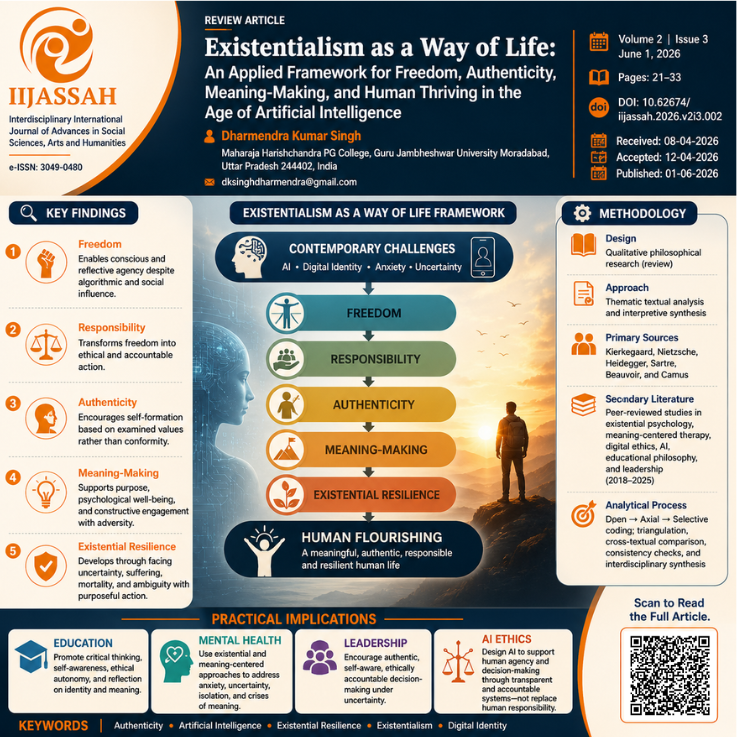
The Applied Existentialistic Framework considers existentialism to be a useful means of navigating issues like AI, digital selfhood, psychological anxiety, and social uncertainty. The framework for the exercise starts with this binary for freedom, which allows one to make choices despite being influenced. We become responsible for our decisions on our own. When people make responsible choices and act from their own examined values; their acting is authentic. People who live authentically make meaning, which can be vital in anything from chaos to changes. Meaning reinforces existential resilience, the ability to confront challenges, uncertainties, and the inevitability of death. Ultimately, each of these facets is interconnected and promotes flourishing among humans, along with other psychological wellness, ethics, and more. The following figure enables an understanding of it.
Existentialism as a Way of Life Framework
Contemporary Challenges
Figure 1. Illustrates the framework of existentialism as a way of life.
Linking Existential Concepts to Contemporary Challenges
Analysis showed core existential concepts are closely related to contemporary social, psychological, and technological challenges. Existential philosophy proposes practical solutions to problems that are becoming more common in today’s world. The concept of freedom involves how one chooses to exercise his or her own will in an algorithmic or mediated world. Authenticity promotes a self-reflective response to pressures from social media and digitally manufactured identities. Having a responsibility establishes an obligation to act ethically amidst uncertainty. The search for meaning in life can help respond to mental distress positively, as it gives purpose and direction in life. When we become aware of our mortality, we tend to live for worthwhile values rather than out of fear. Courage allows us to think for ourselves instead of blindly following the group. Ultimately, self-creation is a way out of the fragmented identity through self-growth and self-reflection. Together, those relationships reflect the applicability of existentialism to modern human problems.
Discussion
The study shows that existentialism is reasonably helpful in the context of contemporary life; thus, there is relevance in it. Existentialist thinking emerged in the wake of the philosophical debates of the nineteenth and twentieth centuries. The enduring strength of existentialism, concerned with themes like freedom, responsibility, authenticity, and meaning, is particularly effective in the context of digital technologies, AI, and rapidly changing social formations. As per Sartre (2007), human beings are condemned to choose. This study confirms Sartre’s assertion. The modern relevance of the principle is more than its philosophical formulation. In the societies where we use digital devices as a matter of routine, what we see and do is determined by the recommendation, advertising, social media, and decision-making tools we use every day. Being free in this sense does not simply mean that I have a choice; it also means that I am capable of making a conscious and reflective choice in the presence of forces outside me that compete with each other. As a result, existentialism offers a crucial corrective to technological determinism by reasserting human agency, which emphasizes the individual’s responsibility to be involved in their own self-creation.
The study of the theme of authenticity illustrates its relevance in the contemporary phase of identity-making. Heidegger's authentic existence and Sartre's bad faith have new relevance in an online environment where selfhood is increasingly made through social performance on the web. Social media often pressures people to present a perfect version of themselves instead of developing a deeper understanding of themselves. According to the results, authenticity can provide a philosophical and ethical resource that helps individuals examine the values, beliefs, and social expectations that dictate their lives. By allowing individuals to stop and reflect on their thoughts, choices, and life, existentialism can allow people to escape from the highly mediated environments and stop being passive and conforming to them. Also, studies now show that authenticity represents an essential factor contributing to one’s psychological well-being, self-esteem, and resilience. In this regard, existentialism does not only provide a philosophical interpretation of identity but also offers a way of living amidst the circumstances of modern social and technological life.
A second contribution of this study is the integration of existential philosophy with present-day mental health issues, meaning-making, and AI ethics. The results coincide with studies in existential psychology showing that people with a strong sense of purpose have greater resilience, well-being, and coping ability (Steger, 2018; Schnell, 2021; Wong, 2020). According to existentialism, meaning cannot be found. Truth does not exist out there. It is created by engagement with life. This study is equally important for debates concerning artificial intelligence and responsibility. According to Floridi (2023) and Coeckelbergh (2023), contemporary scholars argue that technological systems increasingly shape human decision-making and social interaction. Although these technologies can make things more convenient and efficient, they cannot take away responsibility from people. Existentialism is an important moral philosophy that says responsibility cannot be separated from human freedom. Due to its vitality, we believe one can beneficially apply existentialism to challenges in the contemporary world. Furthermore, we can also preserve existentialism’s classical commitment to freedom, authenticity, responsibility, and meaningful living. Thus, one can appropriately think about and act against the modern crises with the help of existentialism.
Limitations
The present study must be seen with certain limitations. It is a qualitative philosophical inquiry based on thematic textual analysis and interpretive synthesis as opposed to empirical observation, survey, interview, and experiment. As a result, the discoveries can be understood and interpreted but cannot be applied statistically to other populations. The selected existential philosophers and contemporary interdisciplinary literature for the study may exclude the potential of other philosophies to address similar existential concerns. Furthermore, the usefulness of the framework has not been tested empirically in any educational-psychological-technology situations. The study is delimited to an examination of existentialism as a way of life through freedom, authenticity, responsibility, meaning-making, and existential resilience. It emphasizes how these ideas relate to contemporary issues, like artificial intelligence and digital identity, mental health, and ethical decision-making of today.
Future scope
Future studies can look at how our framework works in different areas, such as schools, workplaces and tech companies. They can check if it is useful in fields. More research is also needed to see if existential ideas make sense in cultures and with new technologies, like Artificial intelligence, Virtual reality. We need to know if these ideas are still relevant.
Practical Implication
The current study has important implications for education, mental health, leadership, and artificial intelligence ethics. Through existentialism, we may add reflective and valuable experiences to education in order that the students ask fundamental questions about identity, responsibility, meaning, and right and wrong. By engaging with such, critical thinking is cultivated as well as self-awareness, ethical autonomy, and independent thinking in a complex world. The utilization of existential approaches could help deal with anxiety, uncertainty, isolation, and crises of meaning in mental health practice. Counselling and existential therapy can influence us to meaningfully confront our life problems, which can help in self-reflection, taking responsibility for our life circumstances, and living a value-oriented life rather than being a symptom of psychopathology. Effective leadership development also requires the existential principles. An authentic leader must be self-aware, personally integrated, and ethically accountable and must act optimally in the face of uncertainty. Organizations that embrace existentialism become more reflective and deliberate in the actions that they take within their domains. This study will also have real-world ramifications for AI ethics. As AI systems play an ever-growing role in decision-making and social life, they must be controlled by our human structures—not the other way around, incorporating tenets of existentialism: you can’t scapegoat them. Human capability should be a development target. Artificial intelligence must be designed to assist us in our decisions, rather than to replace humans with algorithmic decision-making. This must occur in a transparent and accountable way. We must further educate and empower ourselves to be able to engage with underlying technologies in a critical way. The implications of existentialism show that it can help individuals and institutions to adapt to the present-day problems of ethics, psychology, and technology. Further, it shows that existentialism can serve as a way of guidance.
Conclusion
The present work has analysed existentialism as a tool or a framework with which to reflect upon life today by examining the classical existential literature and drawing on recent interdisciplinary scholarship in psychology, digital ethics, and meaning-centred studies. This research identified five interconnected dimensions: freedom, authenticity, responsibility, meaning-making, and existential resilience that together constitute an applied existential philosophy. Existentialism encompasses a rich and vibrant field in which people make and remake their lives. It began with the project of a world philosophy, building on a rich European tradition of philosophies of existence. On the contrary, it creates a framework for understanding human experience and answering positively to the uncertainties of modernity. Existentialism shifts focus from social, technological, or biological determinism by emphasizing human freedom and the unique ability to redefine oneself as one takes responsibility for one’s life choices.
As per the research, existential thought continues to shed light on important dimensions of human life and remains capable of grappling with contemporary issues in a meaningful way. Researchers say that existentialism is still a necessary philosophy in the modern-day context. The world today, made up of AI, algorithms, social media, and ever-changing technology, is shaping how we think, decide, and socialize. The further developments have raised more issues about autonomy, authenticity, morality, and well-being. Through these challenges, existential philosophy emphasizes reflective choice, personal responsibility, and authenticity of being. The study proposes a contribution to the literature with the integration of scholarly literature from philosophy, existential psychology, digital ethics, and meaning-making literature. The synthesis shows that existential ideas still matter today, especially with respect to mental health, technology, digital identity, and ethical uncertainty. There are also operational consequences here. Existential thought can help humans act in many different ways in contemporary society. For instance, schools can use the principles of existentialism to promote critical thought, self-awareness, and moral reasoning. In addition, mental-health professionals can adopt existential and meaning-centred strategies to enhance resilience and well-being. Leadership development initiatives may be informed by existential ideas concerning authenticity and responsibility. Also, experts examining AI ethics may use insights from existentialism to protect human agency in the automated future.
The true essence of existentialism is that it can raise the most fundamental questions asked by mankind. From the standpoint of existentialism, men must create their own values and meanings, not impose any ready-made doctrines, universal formulas, or fixed meanings on them. It recognizes uncertainty, anxiety, and ambiguity are part of human life. Furthermore, humans can react to this uncertainty with bravery, wisdom, and meaningful action. In today’s world of rapid technological change, social fragmentation, and a need for meaning and identity, existentialism remains a useful philosophy for the conscious, the authentic, and the responsible. These teachings deem people conscious rather than mechanical, authentic rather than conformist, and responsible rather than passive. Through the promotion of the invaluable and active construction of a meaning-centred life, existentialism offers a vision of human flourishing that remains compelling today. It also offers practical help in navigating the ethical, psychological, and technological problems of the twenty-first century.
Conflict of Interest
The author declares that there is no conflict of interest regarding the publication of this paper. All research activities and findings have been conducted and presented with full objectivity and academic integrity.
Acknowledgement
The author expresses heartfelt gratitude to everyone whose guidance, support, and scholarly contributions made this research possible. The author acknowledges an immense intellectual debt to the great philosophers, scholars, and researchers whose works have significantly informed this study and enriched the author’s conceptual understanding of being and the value of existence. The author is also thankful to colleagues, guides, and well-wishers for their suggestions, encouragement, and critical feedback throughout the research process. Their valuable insights and contributions greatly enhanced the quality of this work. The author sincerely appreciates the editorial and review teams for their valuable comments, professional guidance, and commitment to academic excellence, which helped refine and strengthen the study. The author is deeply indebted to family members for their constant support, patience, understanding, and encouragement, which enabled the completion of this research with commitment, persistence, and confidence.
References
- Camus, A. (1983). The myth of Sisyphus : and other essays. Random House.
- Camus, A. (1991). The rebel : an essay on man in revolt (A. Bower, Trans.). Vintage Books.
- Coeckelbergh, M. (2022). The political philosophy of AI: An introduction. Polity Press.
- Coeckelbergh, M. (2023). Digital Technologies, Temporality, and the Politics of Co-Existence. Springer Nature.
- De Beauvoir, S. (1962). The ethics of ambiguity, tr. Citadel Press.
- Floridi, L. (2023). The Ethics of Artificial Intelligence. Oxford University Press.
- Heidegger, M. (1962). Being and Time (J. Macquarrie & E. Robinson, Trans.). Blackwell. (Original work published 1927)
- Kierkegaard, S. (1980). The concept of anxiety (R. Thomte, Trans.). Princeton University Press.
- Kierkegaard, S. (2004). The Sickness Unto Death. Penguin UK.
- Nietzsche, F. (1969). Thus spoke Zarathustra (R. J. Hollingdale, Trans.). Penguin Books.
- Nietzsche, F. (1974). The gay science (W. Kaufmann, Trans.). Vintage Books.
- Sartre, J.-P. (1956). Being and nothingness (H. E. Barnes, Trans.). Routledge.
- Sartre, J.-P. (2007). Existentialism Is a Humanism (C. Macomber, Trans.). Yale University Press. (Original work published 1946)
- Schnell, T. (2021). The psychology of meaning in life. Routledge.
- Steger, M. F. (2018). Meaning and purpose in life. In J. T. Wixted (Ed.), The Stevens' handbook of experimental psychology and cognitive neuroscience (4th ed.). Wiley.
- Turkle, S. (2015). Reclaiming Conversation: The Power of Talk in a Digital Age. Penguin Books.
- van Deurzen, E. (2021). Existential therapy: Distinctive features (2nd ed.). Routledge.
- Wong, P. T. P., Mayer, C.-H., & Arslan, G. (2021). Editorial: COVID-19 and Existential Positive Psychology (PP2.0): The New Science of Self-Transcendence. Frontiers in Psychology, 12. https://doi.org/10.3389/fpsyg.2021.800308
- Wong, P. T. P. (2020). Existential positive psychology and integrative meaning therapy. International Review of Psychiatry, 32(7-8), 1–14. https://doi.org/10.1080/09540261.2020.1814703
- Yalom, I. D. (1980). Existential psychotherapy. Basic Books.